The Direct Answer: Eden AI functions as an umbrella marketplace across dozens of non-generative task types (OCR, translation, classical vision), but lacks the granular per-token governance, prompt-injection defense sidecars, and 4-tier budget ceilings required for enterprise LLM workloads. nRouter replaces the generative half of an Eden AI invoice—routing chat, audio, speech, and embeddings through a single OpenAI-compatible wire with 0% token markup and exact upstream list pricing.
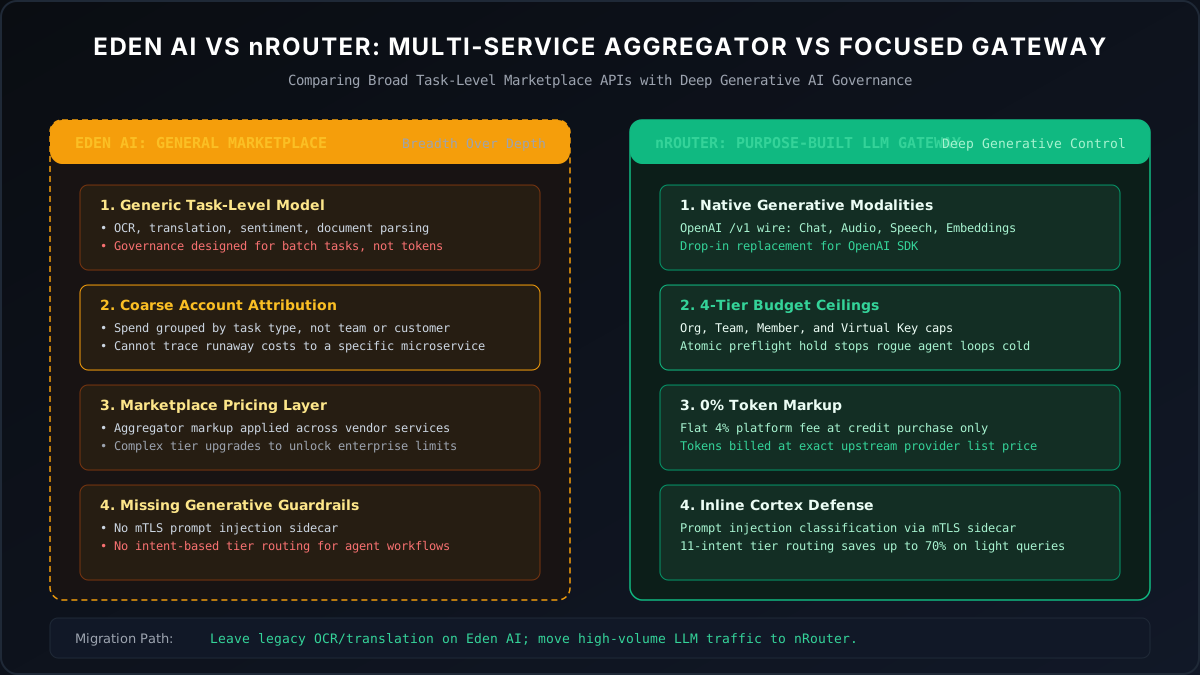
Figure 1: Aggregator vs Specialized Gateway — Decoupling high-volume generative AI inference from legacy OCR/translation tasks to enforce token-level governance and eliminate reseller markups.
Eden AI sells breadth. One account, one SDK, one invoice across a long list of AI task types — text generation, OCR and document parsing, image analysis, speech-to-text, text-to-speech, translation, sentiment, entity extraction — each normalised across several upstream providers. That is a genuine product, and for a team whose product surface really does touch four or five of those task types, it is a defensible default. This post is not an argument that Eden AI is bad at what it does.
It is an argument about a specific shape of bill. If you searched for an Eden AI alternative, the usual reason is that one line on the invoice has outgrown the rest. The LLM line started as one task type among many and is now most of the spend, most of the incident load, and all of the compliance questions — while the tooling around it is still the tooling a marketplace gives every task type equally.
The three walls on the LLM side of a multi-service bill
Wall one: governance that was designed per-task, not per-token. A document OCR call and a chat completion do not need the same controls. OCR needs throughput and accuracy. A chat completion needs a prompt version, a jailbreak check on the input, a PII check on the output, an eval that tells you whether last week's prompt edit made things worse, and a spend ceiling scoped to the team that shipped it. A platform that treats both as "an AI task" tends to build the controls that generalise, and the LLM-specific ones arrive last. Check the current state on docs.edenai.co before you take our word for it — this is a structural prediction about roadmaps, not a claim about a specific missing feature.
Wall two: attribution stops at the task type. When the LLM line is 15% of the bill nobody asks which team spent it. At 70% somebody does, and the answer has to be per-team, per-customer, per-prompt-template — not per-modality. If your current answer is "the text-generation line was $18,400 last month", you do not have cost attribution, you have a category total. We wrote up the mechanism we use for the finer-grained version in LLM cost attribution with tags.
Wall three: you are paying for breadth in roadmap terms, not just in dollars. Every vendor spends its engineering budget somewhere. A horizontal aggregator spends it keeping N task types normalised across M providers, which is a real and unglamorous amount of work. A focused gateway spends it on the one task type. Neither allocation is wrong; they simply produce different products two years out, and you are choosing which one you want to be a customer of.
What nRouter actually serves — and what it does not
This is the section that matters most in an Eden AI comparison, so it goes before the feature table rather than after it. nRouter is narrower than Eden AI on purpose, and the boundary is not vague.
| Task type | Eden AI | nRouter |
|---|---|---|
| Chat / text generation | ✅ | ✅ served |
| Text-to-speech | ✅ | ✅ served (tts-1, tts-1-hd) |
| Speech-to-text | ✅ | ✅ served (whisper-1, gpt-4o-transcribe, gpt-4o-mini-transcribe) — see the OpenAI model index for what each family does |
| OCR / document parsing | ✅ | ❌ not served |
| Image analysis / object detection | ✅ | ❌ not served |
| Translation as a task endpoint | ✅ | ❌ not served |
| Sentiment / entity extraction as a task endpoint | ✅ | ❌ not served |
Two things follow from that table, and both are load-bearing.
First, the migration is not all-or-nothing. Chat, speech synthesis and transcription have a home on nRouter today; the current served list is on /models and it is environment-specific, so check it against your shortlist rather than against this paragraph. The rest of your Eden AI usage stays exactly where it is. Anyone selling you a one-vendor consolidation story here is selling you a rewrite.
Second, the "not served" rows are not a roadmap tease. There is no OCR endpoint coming. If a single SDK across document AI, vision and language is a hard requirement in your architecture review, the honest answer is that this comparison ends here and Eden AI wins it.
Side-by-side: where the two products actually differ
The rows below are the ones where the two products make genuinely different choices. Rows where both are simply fine — OpenAI-compatible request shape, streaming, tool calls — are omitted rather than padded with matching checkmarks.
| Capability | Eden AI | nRouter |
|---|---|---|
| Product scope | Horizontal — many AI task types, one SDK | Vertical — language and audio only |
| Where the roadmap spends | Keeping N task types normalised across M providers | LLM routing, governance, evals, capacity |
| Guardrails on LLM input and output | See docs.edenai.co | Included on every plan |
| Prompt versioning and per-template variants | See docs.edenai.co | Included on every plan |
| Evals against your own traffic | See docs.edenai.co | Included on every plan |
| Per-team and per-customer budget ceilings | See docs.edenai.co | Included on every plan |
| Virtual keys per downstream customer | See docs.edenai.co | Included on every plan |
| Fee shape | Per-task, plan-dependent — see edenai.co/pricing | One platform fee added at purchase: a flat 4% of the credits on every plan, no minimum fee |
| Provider credentials | Per their docs | Managed by nRouter — no keys of yours to paste, see why we do not do BYOK |
| Non-language task types | First-class | Out of scope, permanently |
Every Eden AI cell defers to Eden AI's own published pages rather than quoting a number we would then have to keep fresh. Their per-task pricing and plan gating change on their cadence, and a stale quote in our favour is worse than no quote.
Eden AI is a trademark of its owner. nRouter is not affiliated with or endorsed by them. All claims are sourced from their public pricing or documentation on the dates linked below; if any have changed, email hello@nrouter.ai and we will update.
What Eden AI does better
A comparison with no losses is an advertisement. Four places Eden AI is ahead, and the first two are not close.
- Coverage we will never have. OCR, document parsing, image analysis, translation endpoints, sentiment. If your product extracts fields from scanned invoices and also summarises them, Eden AI does both and we do one. Composing two vendors is a real cost — two contracts, two status pages, two sets of credentials, two invoices to reconcile at month end.
- Provider swapping per task type. The marketplace pattern — change the OCR provider behind a call without touching the call site — is genuinely useful in a domain where provider accuracy varies by document type and you want to re-shop annually. We do that for language models. We do not do it for anything else, and for a document-heavy product that is the wrong half.
- One invoice for the whole AI surface. Finance teams care about this more than engineers expect. Splitting the stack means somebody now maps two vendors onto one cost centre. That is a real ongoing tax and you should price it before you decide.
- A shorter path for prototypes that span modalities. If you are still discovering which AI primitives your product needs, breadth beats depth. Go narrow when you know what you are shipping, not before.
Splitting the invoice before you split the stack
Do this with your own numbers, not ours.
- Isolate the language line. Take last month's Eden AI invoice and pull out text generation, plus speech-to-text and text-to-speech if you use them. Everything else is out of scope for this comparison — set it aside entirely rather than trying to net it off.
- Compute the language share. Language spend divided by total AI spend. Under about half, the split probably is not worth the two-vendor overhead from the previous section. Well over half, and the roadmap-focus argument starts to pay for itself.
- Add the gating you would need. If any LLM-side control you want — guardrails, prompt versioning, evals, per-team ceilings — sits behind a plan tier you would have to buy, that plan's cost belongs in the language column, not spread across every task type.
- Compare against one fee. On nRouter there is one number in that column: the platform fee, a flat 4% of the credits on every plan, added on top when you buy credits rather than as a per-task markup. To put it in your language column, take 4% of spend: $2,500 of monthly language spend carries a $100 fee. Everything else about plans and limits is on /pricing.
Why the governance surface is not one of the things a plan buys is a separate argument with its own home: we charge a fee, not a gate explains what funds it. Short version: the fee is not where the long-term margin comes from.
Cost you can trust: unpriced is never zero
A multi-service bill trains you to distrust cost reporting, because when one task type is metered per page, another per second of audio and a third per thousand tokens, the aggregate is a guess wearing a dollar sign.
nRouter reports per-request cost on the response itself, and the rule that matters is what happens when it does not know:
HTTP/1.1 200 OK
x-nr-request-id: 6b0e2f14-...
x-nr-request-cost: 0.0184
x-nr-cost-status: exact
When the cost cannot be computed — a model whose rate card we do not have, a provider response with unreadable usage — the cost header is absent, and the status says so:
HTTP/1.1 200 OK
x-nr-request-id: 9c71a0b3-...
x-nr-cost-status: unpriced
It is never reported as 0. A zero is a number your dashboard will happily
sum, and summing unknowns as zeros is how a spend report ends up confidently
wrong. The reasoning behind that choice is in
cost honesty, and the practical version — how to
reconcile these headers against the ledger — is in
reading a spend ledger. If you have
been burned by per-unit cost floors across modalities before, the arithmetic
is in multimodal cost floors.
Switch cost: move the language half, leave the rest
nRouter speaks the OpenAI wire format — the request and response shapes
documented in the OpenAI API reference,
as implemented by the official openai Python and Node clients.
If your Eden AI LLM traffic already goes through an OpenAI-compatible client,
the change is two lines:
  const client = new OpenAI({
-   baseURL: 'https://api.edenai.run/v2/llm/chat',
-   apiKey: process.env.EDEN_AI_API_KEY,
+   baseURL: 'https://api.nrouter.ai/v1',
+   apiKey: process.env.NROUTER_API_KEY,
  });
The Eden AI base URL above follows the shape documented at docs.edenai.co and may drift — re-verify at port time. Model-name strings, message arrays, tool-call structures and streaming consumers are unchanged.
What deliberately does not move: every non-language call site. Your OCR client, your image-analysis client, your translation calls all keep pointing at Eden AI. Plan for a period where both SDKs are in the same codebase, because that is the actual end state, not a transition. If that sentence bothers you, it is a signal worth taking seriously — see the last section.
Migrating your Eden AI LLM-side configuration
| What you have | Where it lands |
|---|---|
| Per-call provider preference on the LLM task | A fallback chain in the router config |
| Provider credentials you hold for LLM providers | Retired — nRouter manages upstream credentials |
| Per-task spend caps covering the LLM line | Org, team, user and per-key ceilings |
| Client-side retry around the LLM endpoint | Gateway-side retry and fallback |
| Prompt strings living in application code | Versioned prompt templates |
| OCR, vision, translation configuration | Stays on Eden AI, untouched |
Two things have no equivalent and you should hear them now. There is no document-AI configuration to port, because there is nothing to port it to. And if you were relying on Eden AI to hold the provider keys for both halves, you now hold none for the language half — nRouter manages those — but you still hold whatever Eden AI's model requires for the rest.
Governance that only makes sense once the LLM line is the big one
This is where a focused gateway earns the split, and the examples are deliberately drawn from the multi-service world you are coming from.
- PII checks on text that came out of a document. Extracted text is the highest-risk input a language model in your stack will ever see: it is unstructured, it is customer-supplied, and nobody wrote it expecting a model to read it. That is the indirect-prompt-injection case the OWASP Top 10 for LLM Applications puts first, and personal data extracted from a document stays personal data under the GDPR's purpose and minimisation principles. An output guardrail on the completion that summarises it is worth more than one on a chat box. Setup is in the guardrails guide.
- A ceiling per downstream customer, not per task type. If you resell an AI feature, the ceiling that stops a runaway loop has to be scoped to the customer whose job is looping. That is a virtual key with its own budget, not a category cap — virtual keys vs the master key covers the shape, and four budget ceilings covers which ceiling catches what.
- An eval you can re-run after a prompt edit. The single most common regression in an LLM-heavy product is a prompt change that improved the case the author was looking at and quietly broke four others. Evals are on every plan for exactly that reason.
- A/B across two named models on the traffic that matters. Not a global routing policy — one prompt template, two models, real requests, your own scoring. Cost-vs-Quality LLM Routing walks the method.
When nRouter is the right choice
Two or more of these should be true before you move anything:
- Language and audio are the majority of your AI spend, and the gap is growing rather than closing.
- You have a compliance or procurement question specifically about LLM input and output handling, and the answer needs to be a control you can point at.
- Somebody has asked which team or which customer spent the LLM budget, and you could not answer per-team.
- You resell an AI feature and need a per-customer ceiling that fails closed.
- Your non-language usage is either small, or already isolated behind its own service boundary, so splitting it costs you an environment variable rather than a refactor.
When to stay on Eden AI
Not a straw man. These are the states where we would tell you to stay:
- You genuinely route through three or more task types in production. OCR plus vision plus language in one product is the case Eden AI is built for. Nothing on this page outweighs it.
- Two vendors is one too many for your team's size. A four-person team reconciling two AI invoices and two on-call surfaces is spending its scarcest resource on vendor management.
- A model you depend on is not in our catalogue. Check /models first, not after the migration ticket is written. A gateway that cannot serve your model is not cheaper, it is unusable.
- You need a completed SOC 2 Type II report this quarter. Ours is in progress, not certified, and we say so on /security rather than implying otherwise — the AICPA defines what a SOC 2 examination covers, and "in progress" is not one of its outcomes. The control-by-control view is in a SOC 2 checklist for LLM gateways.
- Your language spend is a few hundred dollars a month. At that scale the fee shape is noise and the governance surface is one you have not started needing. Revisit when either changes.
Try it
Pay as you go starts at $5. Add a card and load the $5 minimum, with the platform fee on top. Point one language call site at the new base URL, leave everything else on Eden AI, and compare a week of real traffic against the ledger before you decide anything further.
→ Get started at app.nrouter.ai/signup
Bring the invoice split from the section above to a walk-through call and we will do the language-line arithmetic with you rather than at you.
Questions? Drop into the public nRouter Slack — #support for
migration questions, #feature-requests if there is an LLM-side capability you
want us to match.
See also
- Multimodal cost floors — why per-image and per-second minimums make a multi-service bill hard to forecast, with the arithmetic worked out.
- Every Feature on Every Plan: We Charge a Fee, Not a Gate — the canonical answer to how a gateway that gates nothing pays for itself.
- Why we do not support BYOK — the reasoning behind managing provider credentials for you, which is the biggest behavioural difference after the switch.
- LLM cost attribution with tags — how to get from a category total to a per-team, per-customer answer.
- Helicone alternative — the other focus-versus-breadth comparison in this cluster, on the observability axis rather than the modality one.
- LLM gateway buyer's guide 2026 — the taxonomy to place both products in before you shortlist.
- Pricing — the plan table and the fee, in one place.
Sources
All Eden AI and provider claims above are sourced from each vendor's public pricing or documentation page. Verified 2026-06-04. nRouter catalogue claims are derived from the live served-model list at /models. If a vendor updates their tiers and we have not refreshed, email hello@nrouter.ai and we will re-audit within one business day.
- Eden AI docs: docs.edenai.co — task-type coverage and the LLM base-URL shape quoted in the switch-cost diff.
- Eden AI pricing: edenai.co/pricing — the per-task fee shape the comparison table defers to.
- OpenAI API reference: platform.openai.com/docs/api-reference — the wire format both the before and after call sites speak.
- OpenAI model index: platform.openai.com/docs/models — the transcription and speech families named in the served-task table.
- Official OpenAI client library: github.com/openai/openai-python — the SDK the two-line base-URL change is made in.
- OWASP Top 10 for LLM Applications: owasp.org — the injection and sensitive-disclosure classes that make extracted document text a guardrail case rather than an input like any other.
- GDPR Article 5: gdpr-info.eu/art-5-gdpr — purpose limitation and data minimisation, which text pulled out of a customer document does not escape.
- AICPA on SOC 2: aicpa-cima.com — what a Type II report is, and why "in progress" is not it.
- nRouter served models: nrouter.ai/models
- nRouter pricing: nrouter.ai/pricing