The Direct Answer: Looking for a Cloudflare AI Gateway alternative? While Cloudflare couples routing to edge Workers and path-bound URLs (
/v1/{account_id}/{gateway_id}with a 20-gateway limit), nRouter provides a host-neutral LLM gateway atapi.nrouter.ai/v1. It runs across any cloud, eliminates path hardcoding, drops card fees to 4% (vs Cloudflare Unified Billing's 5%), and includes inline guardrails and budget caps on every plan.
If you are here because of the binding: the things that make Cloudflare AI Gateway good — an endpoint that lives at
gateway.ai.cloudflare.com/v1/{account_id}/{gateway_id}, a cache you steer per-request withcf-aig-*headers, Workers AI oneenv.AI.run()away — are the same things that make it hard to take with you when half your inference moves off the Cloudflare edge. This post is about that specific trade, with Cloudflare's own numbers, and about what a host-neutral gateway gives up in exchange.
Why teams search for a Cloudflare AI Gateway alternative
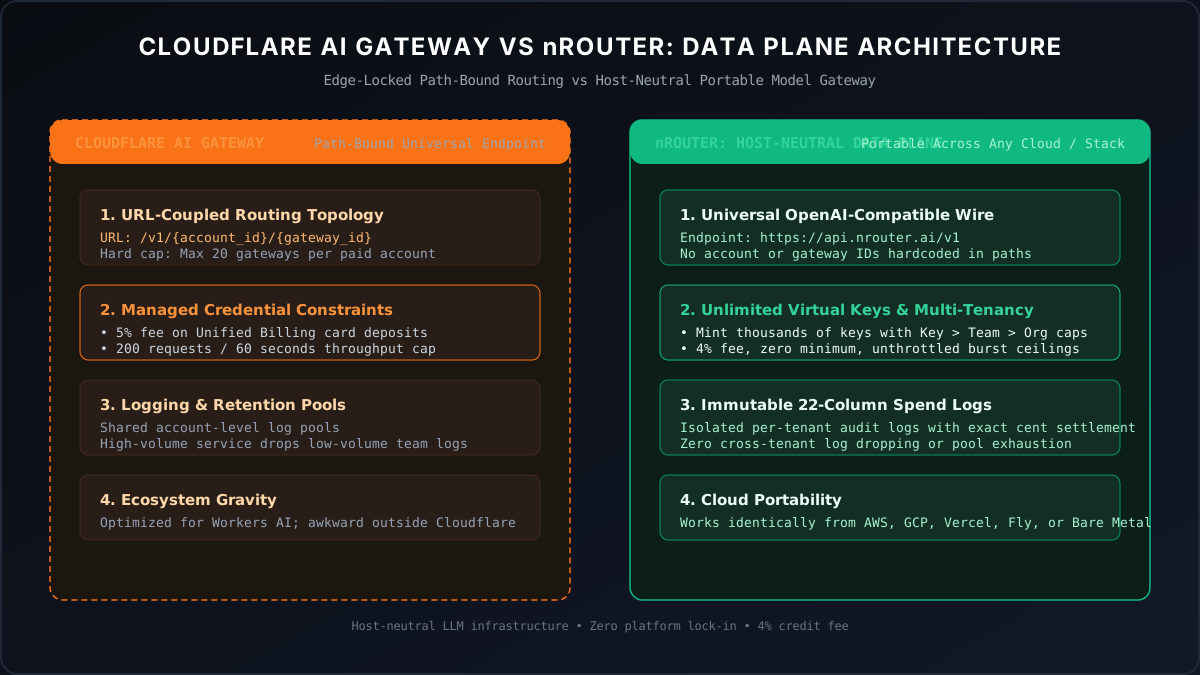
Figure 1: Path-bound edge gateway architecture vs nRouter host-neutral unified data plane.
1. Your account id and gateway id are path segments. The Universal
Endpoint is https://gateway.ai.cloudflare.com/v1/{account_id}/{gateway_id}
(Universal Endpoint docs,
checked 2026-08-23). That is a reasonable REST shape and it has a consequence:
"which gateway am I talking to" is a URL fact, resolved at deploy time, not a
credential fact resolved at auth time. Separating staging from production, or
one customer's traffic from another's, means minting more gateways and
threading more URLs through your config. Gateways are capped at 10 per
account on Free and 20 per account on Paid
(limits,
checked 2026-08-23). Twenty is plenty for environments. It is not plenty if
your instinct was one gateway per tenant.
2. The managed-credential path costs 5% and is capped at 200 requests per 60 seconds. Cloudflare's Unified Billing lets you stop holding provider keys: you buy prepaid credits, Cloudflare pays the providers, and you get one bill. The fee is 5% on the credit purchase — a $100 credit purchase is charged as $105 — with provider inference passing through at standard per-token rates (Unified Billing, checked 2026-08-23). The published limit for that path is 200 requests per 60 seconds per gateway, and Cloudflare states plainly that it does not apply to bring-your-own-keys (limits, checked 2026-08-23). So the escape hatch from the throughput ceiling is to go back to holding provider credentials yourself — the exact chore Unified Billing existed to remove. Credential precedence is documented as request-supplied keys first, then stored BYOK, then Unified Billing.
3. Observability is a log pool with hard ceilings, and one of them is five. Free accounts store 100,000 logs per account across all gateways; Paid stores 10 million per gateway. Individual logs cap at 10 MB, ingestion at 500 logs per second per gateway, cached responses at 25 MB per request, and custom metadata at 5 entries per request (limits, checked 2026-08-23). Ten million is a generous number. Five is not: tenant, environment, feature, end-user, and request source is already five tags, and per-customer cost attribution usually wants more than that before it wants anything else. When the pool fills you choose between deleting the oldest logs and refusing to save new ones — both are lossy in the direction of the data you were keeping logs for.
None of the three is a bug. They are what it looks like when a gateway is a feature of an edge platform rather than a product with its own tenancy model.
Side-by-side, on the axes that differ
Rows below are the ones where the two products make genuinely different
choices. Every Cloudflare and Vercel cell links to that vendor's own docs and
was checked on the date in ## Sources; where a vendor does not publish a
number, this table says so rather than guessing.
| Axis | Cloudflare AI Gateway | Vercel AI Gateway | nRouter |
|---|---|---|---|
| Endpoint shape | Account + gateway id in the path: gateway.ai.cloudflare.com/v1/{account_id}/{gateway_id} | https://ai-gateway.vercel.sh/v1 | https://api.nrouter.ai/v1 — tenancy resolved from the key, not the URL |
| Fee on managed spend | 5% on credit purchase ($100 → $105) | No markup on tokens | a flat 4% of the credits on every plan ($100 → $104.00), no minimum fee |
| Throughput on managed credentials | 200 requests / 60s per gateway (BYOK exempt) | Not published as a single figure | Per-plan rate limits, published on /pricing |
| Provider keys | BYOK, or Unified Billing credits | BYOK on the paid tier, or system credentials | No BYOK — nRouter holds them (why) |
| Log ceiling | 100k/account (Free), 10M/gateway (Paid); 500 logs/s | Not published as a single figure | Usage and spend per key and per team, no purchased log tier |
| Custom metadata | 5 entries per request | Not published as a single figure | Per-team and per-key attribution as first-class scopes |
| Response cache control | cf-aig-cache-ttl, cf-aig-skip-cache, cf-aig-cache-key, status via cf-aig-cache-status | Provider prompt caching via provider options (Anthropic's version, checked 2026-08-23) | Not header-steerable per request |
| Guardrails | ✅ inline prompt + response inspection, log or block | Model allowlist on Pro and Enterprise | ✅ included on every plan |
| Evals, A/B tests, prompt management | Verify on Cloudflare's docs | Verify on Vercel's docs | ✅ included on every plan |
| First-party models at the edge | ✅ Workers AI | — | — |
Cloudflare, Cloudflare AI Gateway, Workers, and Workers AI are trademarks of Cloudflare, Inc.; Vercel and Vercel AI Gateway are trademarks of Vercel Inc. nRouter is not affiliated with or endorsed by either. All claims above are sourced from their public pricing or documentation on the dates linked in
## Sources; if any have changed, email hello@nrouter.ai and we will update.
The cache is the interesting part, and it is exact-match
Cloudflare's cache is the feature most worth understanding before you decide, because it is both the strongest argument for staying and the one most likely to under-deliver against the number in your spreadsheet.
You control it per request. cf-aig-cache-ttl sets a duration, bounded at 60
seconds minimum and one month maximum. cf-aig-skip-cache forces a fresh call.
cf-aig-cache-key overrides the default key. Responses carry
cf-aig-cache-status: HIT or MISS
(caching docs,
checked 2026-08-23). That is a genuinely good API — it puts the decision at the
call site, where the developer knows whether this particular completion is
worth reusing.
The default key is a hash of the provider, the endpoint, the model, the
provider Authorization header, and the full request body. Cloudflare
describes it as exact-match: any variation in the body is a separate entry.
Three things follow, and they are worth checking against your actual traffic
before you model a hit rate:
- A timestamp, a request id, or a shuffled RAG context in the prompt is a cache miss, every time. Most production prompts are templated with per-request data. The share of your traffic that is byte-identical to an earlier request is usually much smaller than the share that is semantically identical, and Cloudflare's own docs list semantic search as a future enhancement rather than current behaviour.
- The key includes the provider auth header. That is correct for isolation — one credential's completions cannot be served to another — and it also means rotating a provider key cold-starts the cache, and that a BYOK fleet with a key per tenant gets a cache per tenant rather than a shared one.
- Two identical requests in flight at once can both miss. Cloudflare documents exactly this: the first may not have cached in time for the second. Cache-stampede-shaped traffic — a deploy, a cron fan-out, a viral page — is the traffic where you most wanted the cache.
nRouter does not expose a per-request cache-control header, and this is a real
gap rather than a design flourish: if cf-aig-cache-ttl at the call site is
load-bearing for your cost model, that is a point for Cloudflare and you should
weigh it as one. What nRouter does instead is put the money controls one layer
up — budgets and rate limits scoped to an organisation, a team, and an
individual key, applied before the provider call rather than after — so the
guarantee is about spend, not about hit rate.
Where Cloudflare AI Gateway is genuinely better
Four things, and they are not throat-clearing.
Workers AI co-location. If your inference is a Cloudflare-hosted model
invoked as env.AI.run(...) from inside a Worker, the gateway sits in the same
request lifecycle as the compute. No network hop leaves Cloudflare. nRouter
cannot match that and does not claim to — the call has to reach
api.nrouter.ai to be governed.
Provider breadth on the managed path. Unified Billing covers OpenAI, Anthropic, Google AI Studio, Google Vertex AI, xAI, and Groq. nRouter's live catalog is Anthropic, OpenAI, Azure AI Foundry, and AWS Bedrock — no Google model is served, and no xAI or Groq model is served. If your shortlist has a Gemini or a Grok model on it, that is disqualifying today and you should stop reading here. The current list is at /models; the honest version of "one API key for every provider" is "one API key for the providers in the live catalog," which is what this post says everywhere else.
Per-request cache control. Covered above. Header-level TTL and key override is more granular than anything nRouter exposes.
Ten million logs per gateway, and the platform around them. On the paid tier, log volume is large and it sits next to the rest of Cloudflare — WAF, DDoS, R2, Vectorize, AutoRAG. If your security and your storage already live there, so does your incident review, and one dashboard is worth real money in a postmortem.
Pricing: the one number that matters here
Against Cloudflare the number is the fee on managed spend: Cloudflare's Unified
Billing adds 5% on credit purchases; nRouter's platform fee is a flat 4% of the
credits on every plan, with no minimum fee, added on top at purchase so the
credits land in full — a $100 load is charged $104.00, a $4.00 fee against
Cloudflare's $5 on the same $100. The full plan
table, the rate limits, and what each subscription's monthly nrouter/auto allowance buys live on
/pricing — one page, kept current, rather than a copy in each
comparison post that drifts.
Two caveats so the comparison stays honest. First, Cloudflare's 5% buys you a platform you may already be paying for, so the marginal cost of the gateway on an existing Cloudflare account is not the whole 5%. Second, if you run Cloudflare with BYOK instead of Unified Billing, the fee is not the axis at all — the axes are the 200-requests-per-60-seconds exemption, the key management you keep, and the log ceiling.
Signup here is not free and there is no trial: a card is required, the minimum credit purchase is $5, and the platform fee is charged on top.
Switch cost: one base URL, one API key
If you call Cloudflare through a provider-specific path or the Universal Endpoint with an OpenAI-compatible client — the OpenAI Node SDK below, or any other client speaking the same Chat Completions contract (both checked 2026-08-23) — the change is two lines:
  // your existing code, OpenAI SDK or any OpenAI-compatible client
  const client = new OpenAI({
-   baseURL: 'https://gateway.ai.cloudflare.com/v1/<account-id>/<gateway-id>/openai',
-   apiKey: process.env.CF_AI_GATEWAY_API_KEY,
+   baseURL: 'https://api.nrouter.ai/v1',
+   apiKey: process.env.NROUTER_API_KEY,
  });
Model strings, message arrays, tool-call structures and streaming consumers do not change. The account id and gateway id leave the URL entirely — with nRouter the tenant is resolved from the key, which is why a key rotation, an environment split, or a per-customer key does not touch a base URL anywhere in your config.
If you call Workers AI through the Cloudflare binding rather than over HTTP,
this is a larger change: env.AI.run(...) becomes a fetch or an OpenAI-SDK
call, and the Cloudflare-hosted model on the other side has no equivalent in
nRouter's catalog. That is a rewrite of the call site, not a config swap, and
it is the honest reason a Workers-AI-native team should not do this migration.
Migrating your Cloudflare-specific config
Maps cleanly. The Universal Endpoint's fallback array — a list of provider objects tried in order — becomes a routing configuration rather than a payload your client assembles per request. Rate limits become per-key limits. Cost analytics become per-key and per-team spend.
Maps differently. Cloudflare's Universal Endpoint expects each element of
that array to carry its own Authorization header, so today your client is
holding provider credentials and choosing the fallback order at call time.
nRouter has no BYOK: the provider credentials are ours to hold and rotate, and
the client sends one sk-nrouter-… key. That is a deliberate trade with real
downsides — you cannot spend provider-granted credits through us, and you
cannot point us at a private deployment of your own — and the reasoning is in
why nRouter does not do BYOK.
Has no equivalent. cf-aig-cache-ttl, cf-aig-skip-cache,
cf-aig-cache-key and cf-aig-cache-status have no counterpart; there is no
per-request cache-control header to port them to. Workers AI models have no
counterpart in the catalog. Custom metadata does not port one-for-one either,
though the five-entry ceiling means most teams are porting fewer tags than they
wish they had.
One thing to check on the way out. nRouter reports an unknown cost as
unpriced and omits the x-nr-request-cost header entirely rather than
sending a zero. If you have dashboards that sum a cost field and treat a
missing value as 0, they will silently under-report instead of showing you a
gap. Read the paired x-nr-cost-status header and treat unpriced as unknown,
not as free.
Why every feature on every plan is sustainable
Short version: the platform fee is not where the margin is meant to come from, so there is no commercial reason to put guardrails or budgets behind an upgrade. The long version — what funds it, what we are betting on, and what would have to change for the position to break — is one post, written once: Every Feature on Every Plan: We Charge a Fee, Not a Gate.
When nRouter is the right choice
Pick nRouter over Cloudflare AI Gateway if two or more of these are true:
- Inference originates from more than one place — Workers and Lambda, Cloud Run, Fly, a Kubernetes pod, a laptop — and you want one governance plane over all of it rather than one per host.
- You want to stop holding provider credentials entirely, and the 200 requests / 60 seconds ceiling on Cloudflare's managed path is below where your traffic is heading.
- Your cost attribution needs more than five metadata entries per request, or needs budgets that refuse a call rather than dashboards that report one.
- You need guardrails, evals, A/B tests, prompt management and per-team budgets now, on the cheapest plan, without a Cloudflare account-plan conversation.
- Your shortlist is Anthropic, OpenAI, Azure AI Foundry and Bedrock models, which is what the live catalog serves.
When to stay on Cloudflare AI Gateway
Stay if any of these is true. These are disqualifying, not close calls:
- A Gemini, Vertex, xAI or Groq model is on your shortlist. nRouter serves none of them.
- Your inference is Workers AI invoked through the binding. The migration is a call-site rewrite with no model on the other side.
cf-aig-cache-ttlat the call site is doing real work in your cost model and your traffic is genuinely byte-repetitive.- You are already paying for Cloudflare's platform, your LLM spend is small enough that 5% of it is noise, and the gateway is one more thing on a bill you already reconcile.
- You want ten million logs per gateway retained next to your WAF and DDoS events, in one incident-review surface.
For everyone else — multi-host teams, teams whose attribution needs outgrew five tags, teams who would rather never hold an OpenAI key again — the switch is the two lines above.
Try it
Pay as you go starts at $5. Load the $5 minimum, with the platform fee on top and no subscription. That is enough to wire a guardrail, set a team budget low enough to watch it refuse a call, and run an A/B test across two models before you decide anything.
→ Get started at app.nrouter.ai/signup
Weighing pay as you go against a subscription? Bring your current Cloudflare bill and your
Workers AI usage report to a 30-minute call and we will do the plan math
live. Questions go to the public nRouter Slack — #support for
migration, #feature-requests if there is a Cloudflare capability you want us
to match.
See also
- Vercel AI Gateway alternative — the other platform-bundled gateway, where the coupling is BYOK, budgets and OIDC rather than the edge.
- Helicone alternative — the observability-first comparison, where the wall is a retention window.
- OpenRouter alternative — the head-term comparison in this cluster.
- No BYOK: One nRouter Key Instead of Ten Provider Keys — the position behind the credential row in the table above.
- Every Feature on Every Plan: We Charge a Fee, Not a Gate — how one flat fee with no feature gates is meant to pay for itself.
- LLM gateway buyer's guide 2026 — the buyer-stage taxonomy for this whole cluster.
- Pricing — the canonical plan table.
Sources
Every Cloudflare and Vercel claim above is sourced from that vendor's own public documentation and was checked on 2026-08-23. If a vendor has changed a number since, email hello@nrouter.ai and we will re-audit within one business day.
- Cloudflare AI Gateway overview, checked 2026-08-23: developers.cloudflare.com/ai-gateway
- Cloudflare AI Gateway Universal Endpoint, checked 2026-08-23: developers.cloudflare.com/ai-gateway/usage/universal
- Cloudflare AI Gateway limits (gateways per account, log ceilings, 500 logs/s, 25 MB cache, 5 metadata entries, 200 req/60s on managed credentials), checked 2026-08-23: developers.cloudflare.com/ai-gateway/reference/limits
- Cloudflare AI Gateway Unified Billing (5% credit fee, provider coverage, credential precedence), checked 2026-08-23: developers.cloudflare.com/ai-gateway/features/unified-billing
- Cloudflare AI Gateway caching (
cf-aig-cache-ttl,cf-aig-skip-cache,cf-aig-cache-key,cf-aig-cache-status, exact-match keying), checked 2026-08-23: developers.cloudflare.com/ai-gateway/features/caching - Cloudflare AI Gateway Guardrails, checked 2026-08-23: developers.cloudflare.com/ai-gateway/features/guardrails
- Cloudflare Workers AI pricing, checked 2026-08-23: developers.cloudflare.com/workers-ai/platform/pricing
- Vercel AI Gateway docs (no token markup, BYOK), checked 2026-08-23: vercel.com/docs/ai-gateway
- OpenAI Chat Completions reference — the contract both gateways serve, and the reason the switch is a base-URL edit rather than a rewrite, checked 2026-08-23: platform.openai.com
- OpenAI Node SDK — the client in the diff above, and its
baseURLoption, checked 2026-08-23: github.com/openai/openai-node - Anthropic prompt caching — the provider-side caching the Vercel column refers to, which is a different mechanism from a gateway response cache, checked 2026-08-23: docs.anthropic.com
- nRouter pricing: /pricing · nRouter live catalog: /models