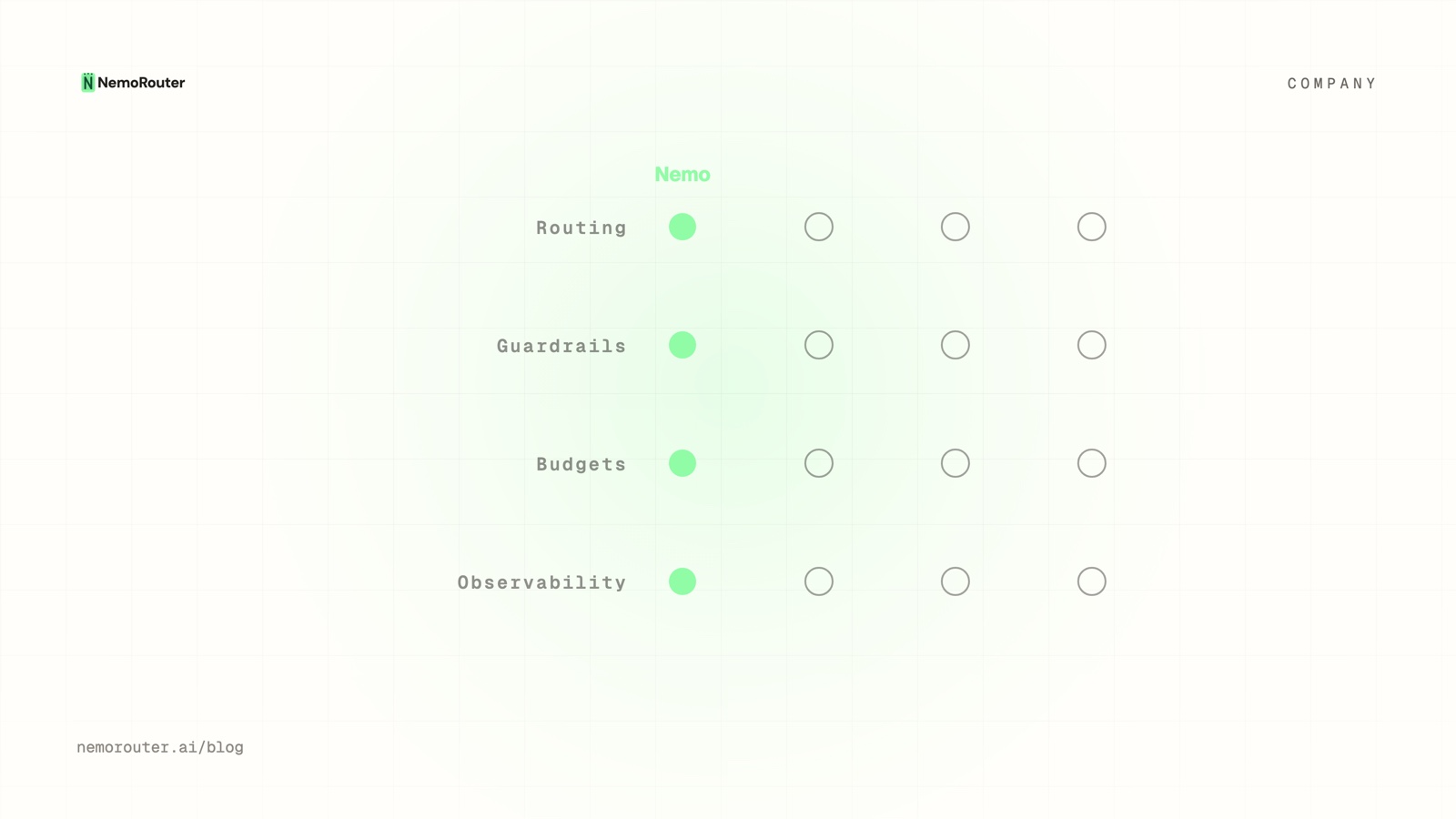
The position: every nRouter plan carries every feature. Guardrails, audit trails, per-team budgets, evals, A/B tests, prompt management and fallback chains are on the entry plan exactly as they are on the top one. Plans change two things — the monthly
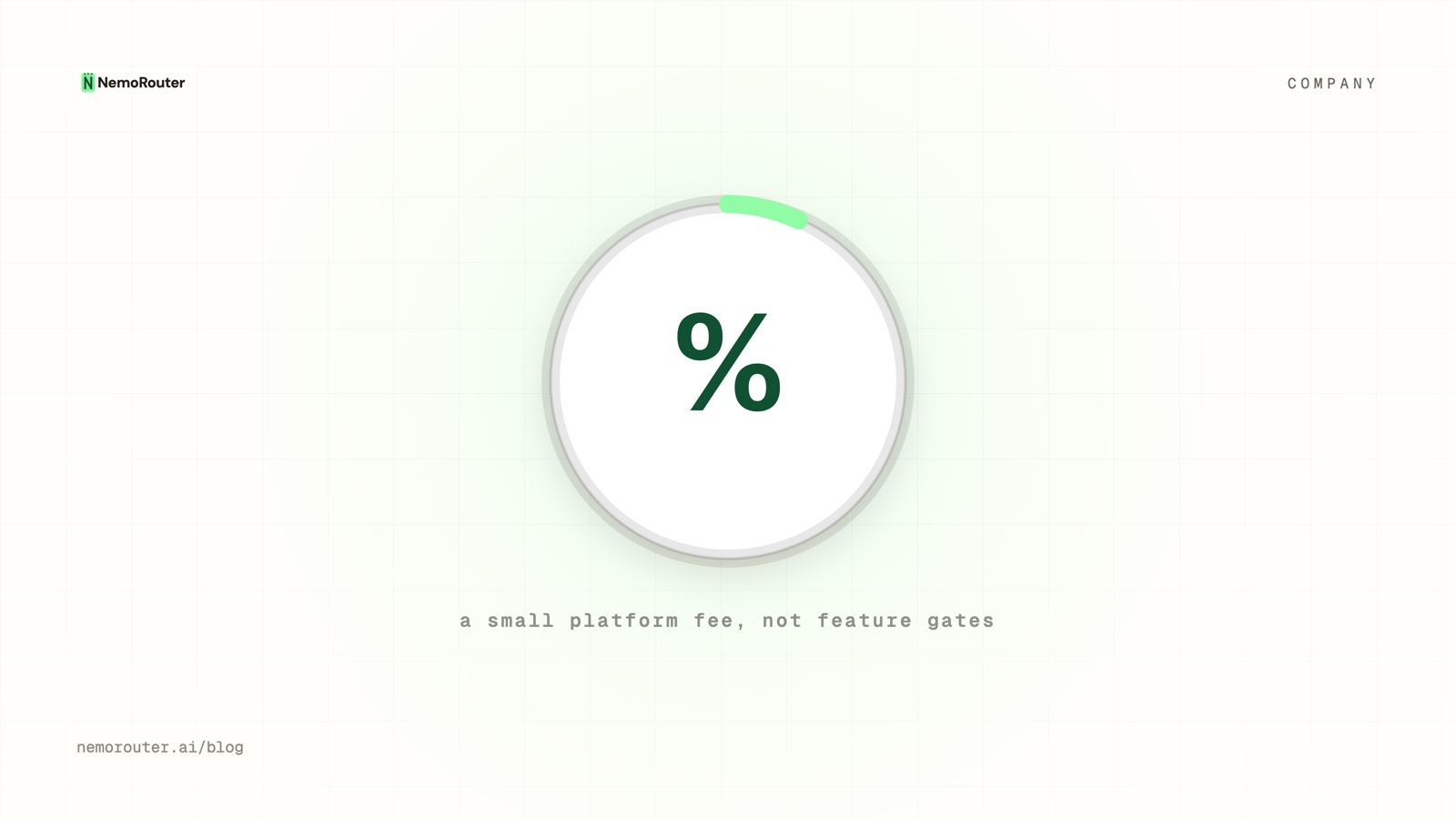
nrouter/autoallowance and the rate limits — and nothing else. The platform fee is the same 4% on every one of them.
The industry norm is the opposite, and the norm has a good argument behind it. So this post takes that argument seriously, shows the math on both sides, states what our choice costs you, and names the buyers for whom our pricing is genuinely the wrong shape.
The position
There is no entitlement matrix here. There is no "available on Enterprise" column, no feature flag keyed to a plan, and no upgrade prompt attached to a capability. If a control exists in the product, it is on your account from your first request.
What the plans move is money and throughput:
Pay as you go    every feature ✓   platform fee 4% of credits   no allowance             lower RPM/TPM
Starter $20/mo   every feature ✓   platform fee 4% of credits   $60/mo nrouter/auto      higher RPM/TPM
Pro $50/mo       every feature ✓   platform fee 4% of credits   $100/mo nrouter/auto     higher RPM/TPM
Max $200/mo      every feature ✓   platform fee 4% of credits   $400/mo nrouter/auto     higher RPM/TPM
Enterprise       every feature ✓   custom terms                                          custom RPM/TPM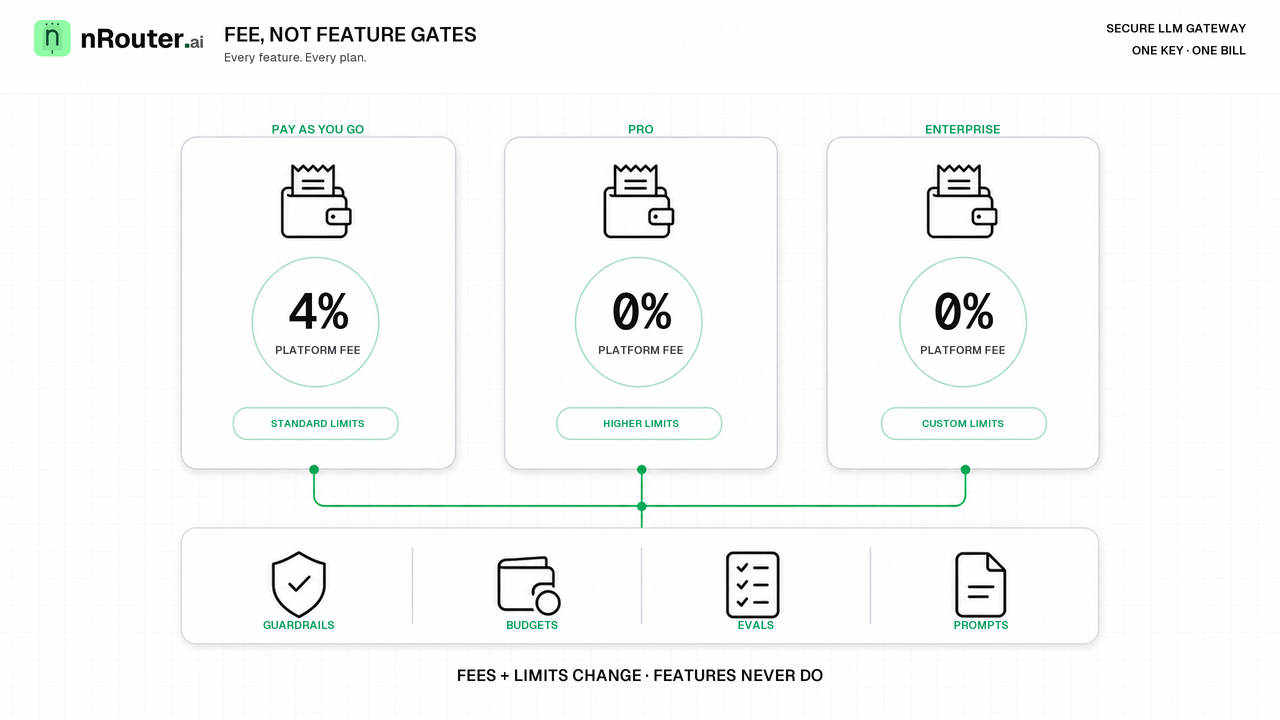
Figure 1: Transparent pricing philosophy: Every governance, security, and routing feature is available on every tier.
The platform fee is charged on top at purchase time, and it is a flat 4% of the credits: $100 of credits is charged $104.00, and the full $100 lands on your balance. It is not skimmed out of a per-call rate, and it does not sit as a margin on the model price — that mechanism is markup-free credits, and it is the other half of this position.
What we were asked for instead
Put the strongest version of the counter-argument up front, because a position argued against a weak version of the ask persuades nobody.
"Gate the enterprise features. It is the standard model, and it works."
- It funds the product. SSO, audit export, advanced RBAC and compliance features are disproportionately expensive to build and are wanted by disproportionately well-funded buyers. Charging those buyers for those features is how the rest of the product gets built and stays cheap for everyone else.
- It lets small teams pay less. A stripped entry plan can be priced near zero precisely because it is stripped. Bundling the whole governance surface into every plan means the entry plan has to carry some of that cost.
- It matches how buying actually happens. An enterprise buyer expects a line item and a negotiation. A tier is a legible artifact for procurement in a way that "everyone gets everything" is not.
- It creates a natural expansion path. Land small, expand when the customer needs the next capability. That is a well-understood, well-behaved revenue motion.
Every one of those is true. We are not claiming the standard model is stupid; we are claiming it produces one specific outcome we are unwilling to ship.
What that would cost you
The outcome is this: the customers with the least margin for an incident are the ones priced out of the controls that prevent incidents.
Look at what typically sits above the gate, and who needs it most:
| Gated capability | Who is usually on the entry plan | What the gap costs them |
|---|---|---|
| PII redaction in logs | A three-person team shipping fast | Personal data in a log store nobody audits |
| Audit trail of admin actions | The team with no dedicated security hire | No answer to "who changed that key" |
| Hard spend caps | The team with the smallest runway | A runaway loop that empties the account |
| Per-key rate limits | The team with one shared key | One bad deploy exhausting everyone's quota |
| Guardrails on output | The team with no review process | A prompt-injected response reaching a user |
A large company that hits the gate writes a check. A four-person startup that hits the gate ships without the control, tells itself it will revisit at Series A, and does not. The gate does not convert that customer; it just removes their seatbelt.
Money makes it concrete. A single runaway agent loop costing $2,000 in a weekend dwarfs the price difference between any two plans — and a hard spend cap is precisely the feature most likely to be sitting behind one. The protection is worth more than the tier that hides it, to the customer who cannot afford either.
What the plans actually change
Here is every difference, with nothing omitted:
| Pay as you go | Starter | Pro | Max | Enterprise | |
|---|---|---|---|---|---|
| Subscription | $0 | $20/mo | $50/mo | $200/mo | Custom |
| Platform fee | 4% of the credits, added on top | 4%, added on top | 4%, added on top | 4%, added on top | Custom terms |
Monthly nrouter/auto allowance | — | $60 | $100 | $400 | Custom |
| Rate limits (RPM/TPM) | Lower | Higher | Higher | Higher | Custom |
| Guardrails, budgets, RBAC, audit | Included | Included | Included | Included | Included |
| A/B tests, prompt management, evals | Included | Included | Included | Included | Included |
| Fallback chains, routing controls | Included | Included | Included | Included | Included |
| Minimum credit purchase | $5 | $5 | $5 | $5 | Custom |
Three rows differ — the subscription, the allowance and the limits. Everything else, the platform fee included, is a constant. The canonical version of this table is pricing, and if this post ever disagrees with it, the page is right and the post is a defect.
The fee, worked
Because the difference between plans is never a feature, you can compute what you will pay instead of guessing at it. Because the fee is 4% of the credits on every plan, with no minimum fee, the fee on a month's provider spend is 4% of that spend:
| Monthly provider spend | Fee (4% of spend) | Charged for those credits |
|---|---|---|
| $250 | $10.00 | $260.00 |
| $750 | $30.00 | $780.00 |
| $2,500 | $100.00 | $2,600.00 |
| $10,000 | $400.00 | $10,400.00 |
That is the whole fee calculation, on every plan. A subscription does not lower
it; what a subscription buys is a monthly nrouter/auto allowance — $60 on
Starter, $100 on Pro, $400 on Max — and higher rate limits. The
cost calculator runs this against your own numbers, and
from credits to Pro walks the
switch in detail.
Notice what this table does not contain: a capability you would gain by moving up. Upgrading is an arithmetic decision, not a hostage negotiation.
What we do instead
Every control is live from your first request. Concretely, what "included" means:
- Guardrails on every request, pre-call and post-call, not as an add-on: Inline LLM Guardrails: Redact, Block, or Flag Every Request and the guardrails guide.
- Budgets at org, team and key scope, with a hard refusal rather than an alert after the fact: how to set hard spend limits.
- Rate limits per key, team and org so one workload cannot starve another: RPM and TPM limiting.
- PII redaction in logs without losing the ability to debug: redacting PII from LLM logs.
- An audit trail of administrative actions, from day one: building a tamper-evident audit trail and the audit log guide.
- Team-scoped keys, budgets and guardrails so the org chart is expressible: org, team, member scoping.
- A/B tests and prompt management as first-class surfaces rather than enterprise extras: deterministic A/B testing and server-side prompt templates.
That list is the product. It is not the top tier of the product.
The trade we are making
The honest accounting, because this bet is not free.
We leave revenue on the table, deliberately. A vendor that bundles SSO and audit export into a negotiated enterprise contract books more per large customer than we can, because we already handed those capabilities to that customer on the entry plan. That is not a rounding error; it is the single most reliable expansion lever in B2B software and we do not have it.
Our revenue tracks your spend, which cuts both ways. A 4% fee grows when your usage grows and shrinks when it shrinks. That aligns us with your success and it also means a customer who optimizes their prompts pays us less. We think that is the correct incentive — it means our only path to more revenue is your gateway being genuinely worth using, and it is why cutting your costs is something we write about rather than quietly discourage.
Our entry plan is not free. Because the whole surface is included, it has to be paid for. Signup is card-required and takes a real $5 minimum charge with the fee on top. A competitor with a stripped free tier will always be able to say a shorter word than we can.
Procurement sometimes wants a gate. More than once, a buyer has asked what they get for moving up and been unsatisfied by "an allowance and higher limits." The absence of a feature ladder can read as a missing enterprise story, and we have to argue our way through that rather than pointing at a tier chart.
Who this is wrong for
Choose a differently-shaped vendor if:
- You want a genuinely free plan and do not need governance. If your usage is a hobby project and controls are not the point, a vendor with a free observability tier will serve you better than our $5 floor. We are not competitive on "costs nothing".
- Your spend is very large and very steady, and you want a bespoke contract shaped around specific capabilities. Our answer is custom terms and custom limits via enterprise — but if your procurement process needs a capability-by-capability negotiation, our uniform feature set makes that conversation shorter than you may want it to be.
- You need exactly one narrow capability and nothing else. If all you want is request logging, a focused observability tool priced for that one job may cost less than a gateway that includes eleven things you will not use. Our bundle is only a bargain if you use the bundle.
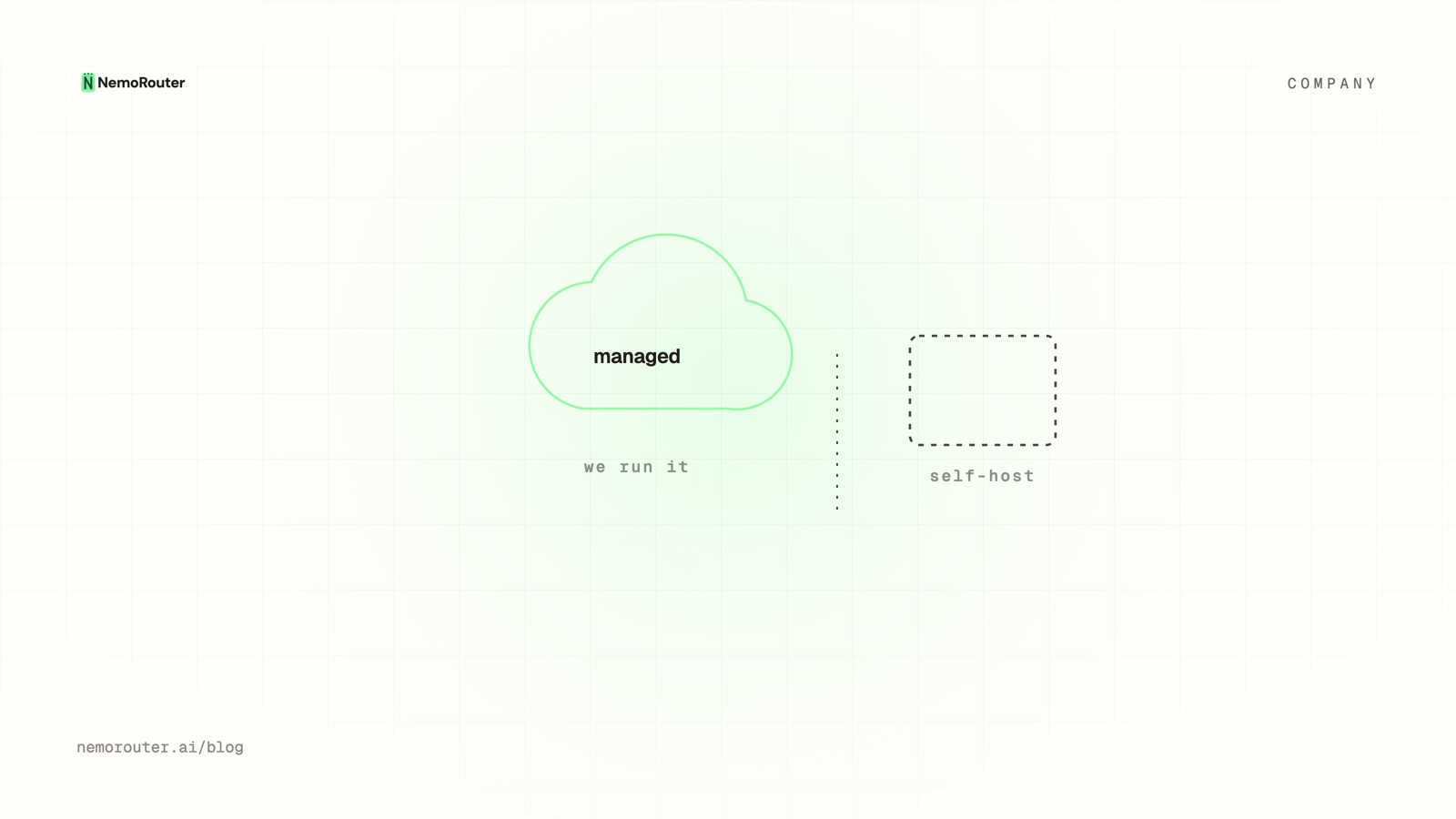
- You must run on your own infrastructure. Different axis, same honesty: see Managed LLM Gateway vs Self-Hosted: Why We Carry the Pager.
How you can hold us to it
This position is unusually easy to falsify, which is the point:
- Open the pricing page. Pricing is the source of truth for the fee, the plans, the limits and the minimum. If it ever grows a feature column that differs by plan, we broke this promise and you can point at it.
- Try a governance feature on the entry plan. Set a budget, enable a guardrail, create a second team, export an audit log — on pay as you go. If any of it prompts you to upgrade, that is a bug and we want the screenshot.
- Check where the fee is charged. It is added at purchase, on top of the amount you load. Compare the amount that lands on your balance with the amount you paid: the credits arrive in full and the fee is a separate line, never a haircut on the model rate. That is markup-free credits as an arithmetic claim rather than a slogan.
- Reconcile the ledger. Every movement is a row: how to read your credit ledger. A fee that appears anywhere other than where we say it appears is visible there.
- Compare the model price to the provider's. The rate you are charged for a model should be the provider's list rate — open OpenAI's or Azure OpenAI Service's page next to your ledger row and check the per-million-token figure yourself. The rest of the rate cards are in Sources and the catalog is on models.
- Read the comparisons. Our head-to-head posts state, with dated links to each vendor's own pricing page, which capabilities sit behind which tier elsewhere — for example Helicone and Portkey. If we have misrepresented anyone, the link is right there to check us with.
Try it
Test the claim on the cheapest plan, which is where a gate would show up if there were one. Load the $5 minimum, then set a budget and a guardrail before you send a single production request:
# 1. a real call, on pay as you go
curl https://api.nrouter.ai/v1/chat/completions \
  -H "Authorization: Bearer $NROUTER_API_KEY" \
  -H "Content-Type: application/json" \
  -d '{"model":"MODEL_FROM_YOUR_CATALOG","messages":[{"role":"user","content":"ping"}]}' \
  -i | grep -i '^x-nr-'

# 2. now go set a hard cap and a guardrail in the dashboard,
#    on the same plan, with no upgrade in the way.
Then walk budget controls, guardrails and API key management and confirm none of them asks you for a plan change. Signup takes a real $5 minimum charge with the platform fee on top. Start at signup, price it on the cost calculator, or bring the sceptical version of this argument to the community.
See also
- Markup-free LLM credits — where the fee is charged and why the model rate stays the provider's rate.
- Inline LLM Guardrails: Redact, Block, or Flag Every Request — the single feature this position is most often tested against.
- How to set hard spend limits — the control a gated plan most commonly withholds from the customer who needs it most.
- From credits to Pro — moving from pay as you go to a subscription, walked in detail.
- Managed LLM Gateway vs Self-Hosted: Why We Carry the Pager — the operational half of what the platform fee actually pays for.
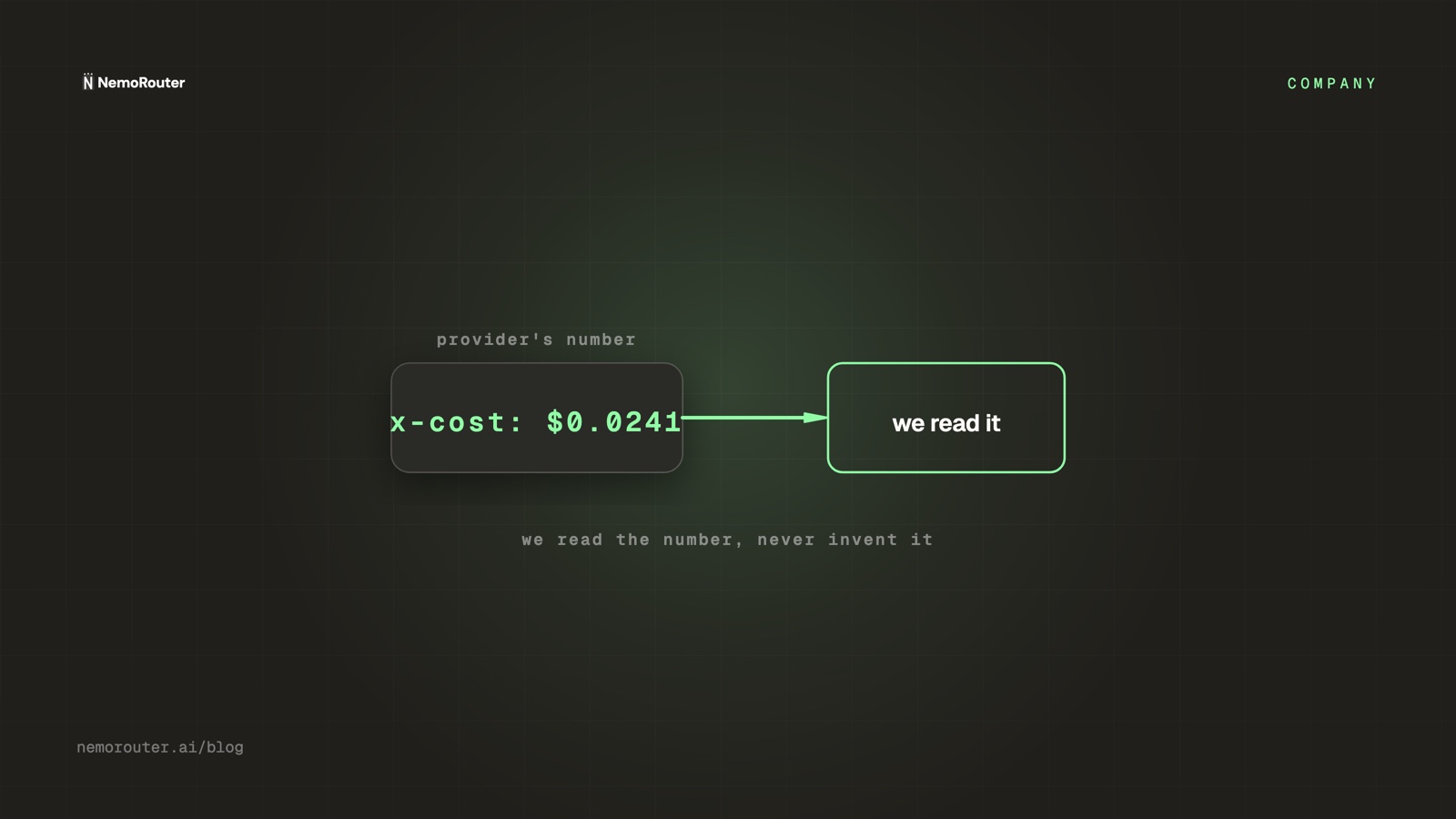
- Cost honesty — the same stance applied to a single number: an unpriceable call is unpriced, never zero.
- Pricing — the canonical fee, plans and limits; this post defers to it.
Sources
Verified 2026-08-23. Corrections to hello@nrouter.ai and we will update.
Competitor names appearing above are trademarks of their owners. nRouter is not affiliated with or endorsed by them. This post makes no new claim about any other vendor's tier contents — the vendor-by-vendor gating claims live in the comparison posts linked in the previous section, each carrying its own dated link to that vendor's public pricing page. The nRouter figures here (4% platform fee on every plan, the $20, $50 and $200 monthly plans and their allowances, $5 minimum purchase) are authoritative on our pricing page rather than in this post. The provider rate cards are listed because they are what the "model price is the provider's price" check in the previous section compares against.
- nRouter pricing: nrouter.ai/pricing
- nRouter model catalog: nrouter.ai/models
- Anthropic pricing: anthropic.com/pricing
- OpenAI API pricing: openai.com/api/pricing
- AWS Bedrock pricing: aws.amazon.com/bedrock/pricing
- Google Vertex AI generative-AI pricing: cloud.google.com/vertex-ai/generative-ai/pricing
- OpenAI pricing, developer-docs copy: platform.openai.com/docs/pricing — the per-million-token rates check 5 compares a ledger row against.
- Azure OpenAI Service pricing: azure.microsoft.com — the same check for a model served through Azure.
OpenAI, Anthropic, AWS, Microsoft and Google are trademarks of their respective owners. nRouter is not affiliated with or endorsed by them.