The Direct Answer: Searching for a Helicone alternative? While Helicone excels at post-call observability, essential governance features (guardrails, custom rate limits, evals) are gated behind their $79/mo Pro plan, with data retention strictly capped at 30 days. nRouter is an inline LLM edge gateway that enforces preflight guardrails and dynamic budgets on every plan, with permanent immutable spend logging and a flat 4% platform fee on credits.
If you are here because of the Pro line: you adopted Helicone to see your LLM traffic, it did that job, and the next three things you need — a guardrail, an eval, a rate limit — all sit above a $79/mo line, with SOC-2 and HIPAA a further $720/mo above that. This post is about whether that ladder is the right one to climb, and about the second ceiling most teams do not price until later: how long an observability product keeps the data you are paying it to collect.
Why teams search for a Helicone alternative
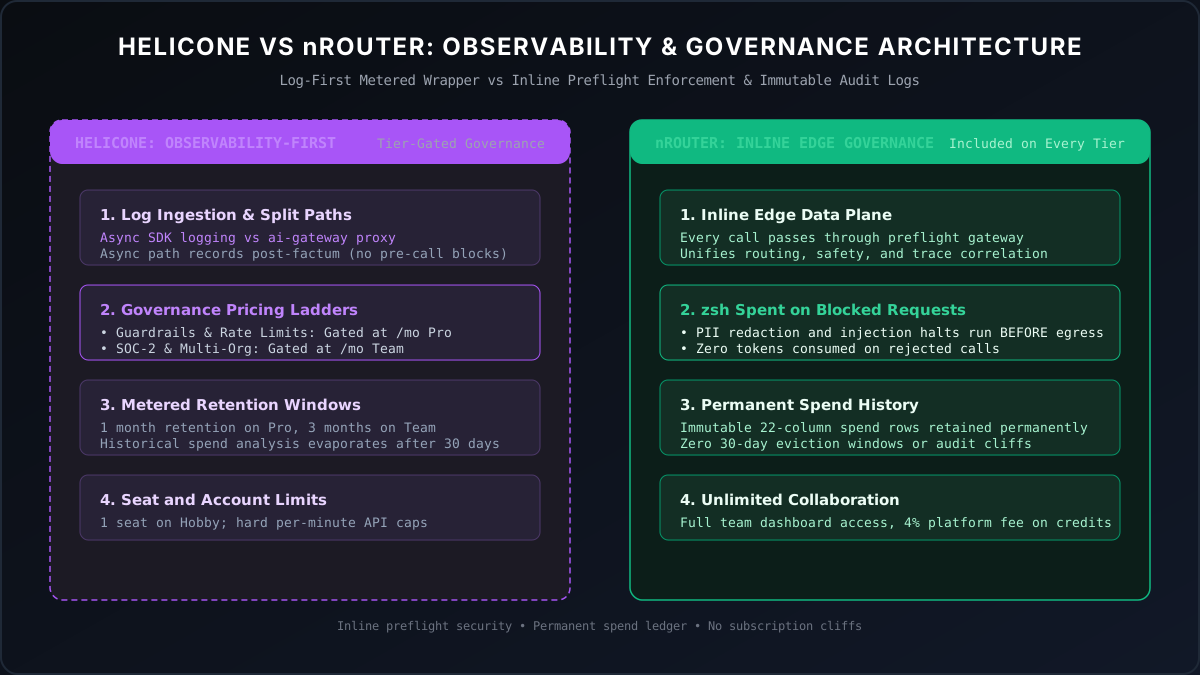
Figure 1: Metered post-call logging wrapper vs nRouter inline preflight data plane.
1. Governance starts at $79/mo, and compliance at $799/mo. On Helicone's published pricing, Hobby is free and carries no advanced monitoring; guardrails and custom rate limits, evaluations (Scores), prompt management, sessions and alerts all begin on Pro at $79/mo. SOC-2 and HIPAA compliance, five organisations and a dedicated Slack channel begin on Team at $799/mo; SAML SSO and on-prem deployment are Enterprise (helicone.ai/pricing, checked 2026-08-23). That is a coherent commercial design. It also means the first time you need to block something rather than watch it, the answer is a plan change.
2. The observability itself is metered, and the meter that bites is retention. Data retention is 1 month on Pro, 3 months on Team, and forever only on Enterprise. Log ingestion is capped at 1,000 logs/min on Pro and 15,000 on Team; API access at 60 calls/min on Pro and 1,000 on Team. Hobby is 10,000 requests/month, 1 GB of storage and 1 seat (same page, checked 2026-08-23). One seat is worth pausing on: the free tier of a dashboard product cannot be shown to a second person.
3. There are two integration paths and they govern differently. Helicone
can sit in the request path as a gateway at ai-gateway.helicone.ai, or out of
band via the async-logging SDK, where your calls go straight to the provider
and Helicone records them afterwards
(docs.helicone.ai/gateway/overview,
checked 2026-08-23). The async path is excellent for observability and cannot,
by construction, enforce anything — nothing that is not in the request path can
refuse a request. Teams often adopt async first for the latency story, then
discover that the guardrail they bought is on the path they are not using.
Side-by-side, on the axes that differ
Rows chosen where the products make genuinely different choices. Every Helicone
and Cloudflare cell traces to that vendor's own published pricing or docs,
checked on the date in ## Sources. Helicone's column says "Pro" or "Team"
rather than "missing" on purpose: Helicone ships these capabilities. The
substantiable difference is on which plan, not whether they exist.
| Axis | Helicone | Cloudflare AI Gateway | nRouter |
|---|---|---|---|
| Entry price | Hobby $0 — 10k requests/mo, 1 GB, 1 seat | Free plan, gateway features by account plan | $0 subscription; $5 minimum credit purchase |
| Where guardrails begin | Pro, $79/mo | Included, log-or-block | Every plan |
| Where evals and prompt management begin | Pro, $79/mo | Verify on Cloudflare's docs | Every plan |
| Where custom rate limits begin | Pro, $79/mo | Included | Every plan |
| Data retention | 1 month (Pro), 3 months (Team), forever (Enterprise) | 100k logs/account (Free), 10M/gateway (Paid) | Ledgered spend history, not a purchased retention tier |
| Ingestion ceiling | 1,000 logs/min (Pro), 15,000 (Team), 30,000 (Enterprise) | 500 logs/s per gateway | Per-plan rate limits, published on /pricing |
| Seats | 1 (Hobby), unlimited (Pro and above) | Cloudflare account users | Team members within one organisation |
| SOC-2 / HIPAA | Team, $799/mo; SAML SSO and on-prem on Enterprise | Cloudflare platform compliance | SOC 2 Type II in progress |
| Provider credentials | BYOK, or Helicone credits at 0% markup | BYOK, or Unified Billing at a 5% credit fee | No BYOK — nRouter holds them (why) |
| Enforcement position | Gateway path enforces; async SDK path observes only | Request path | Request path only |
Helicone is a trademark of its owner; Cloudflare and Cloudflare AI Gateway are trademarks of Cloudflare, Inc. nRouter is not affiliated with or endorsed by either. All claims above are sourced from their public pricing or documentation on the dates linked in
## Sources; if any have changed, email hello@nrouter.ai and we will update.
The retention window is the decision nobody prices
Every other row above is a line item. This one changes what questions you can answer.
A one-month window on Pro means that on 1 March you can see February. You cannot see January, so you cannot answer "is this feature's cost per user trending up over the quarter" without exporting first — through an API capped at 60 calls per minute on that same plan. You cannot open an incident from six weeks ago and read the actual requests. You cannot compare this quarter's model mix to last quarter's. Three months on Team is enough for a quarterly review and not enough for a year-over-year one; forever is an Enterprise conversation.
There is nothing unusual about this — storage costs money and every logging vendor prices it. It is worth naming because it is the axis on which an observability-first product and a governance-first one diverge most quietly: one sells you a window onto your spend, the other sells you a limit on it, and the two failure modes look nothing alike. A window that closed loses you an answer. A limit that was never enforced loses you money.
nRouter's side of that trade is deliberately narrower. Spend is ledgered per key and per team, and ceilings are applied before the provider call rather than summarised after it — an exhausted organisation, team or user ceiling refuses the request, and an exhausted per-key ceiling refuses only that key's requests while the rest of the team keeps working. What nRouter does not offer is Helicone's depth: no session replay, no query language over your traces, no dataset builder. If your primary requirement is analysis rather than enforcement, that is not a gap you should let a comparison post talk you out of.
One consumer-side detail, since it changes how you read any cost dashboard you
build on top: nRouter reports an unknown cost as unpriced and omits the
x-nr-request-cost header entirely rather than sending a zero, paired with
x-nr-cost-status. Code that treats a missing cost as 0 will under-report
instead of showing a gap.
What Helicone does better
Observability out of the request path. The async-logging SDK is genuinely the right architecture for a logging product: no added latency, and Helicone being down does not stop your inference. nRouter is in the path by design — that is what lets it enforce — and being in the path is a real availability consideration you should weigh rather than wave at.
Depth of analysis. Sessions, user analytics, custom properties, scores, datasets, webhooks, a playground, and HQL over all of it. That is a mature, well-shaped analysis product. nRouter has usage and spend views tied to teams and keys, which is a different and smaller thing.
Compliance you can buy today. SOC-2 and HIPAA on the Team plan, SAML SSO and on-prem on Enterprise. nRouter's SOC 2 Type II is in progress — in progress, not certified — and a team with a compliance requirement this quarter should take a shipped attestation over a roadmap without apology.
Provider breadth and credit flexibility. Helicone's credits path covers a far wider provider list than nRouter's live catalog, including Google models that nRouter does not serve at all, and 0% markup on that path is cheaper than nRouter's platform fee of 4% of your credits. And Helicone supports BYOK; nRouter does not, so provider-granted credits and negotiated rates cannot be spent through us.
Pricing: the one number that matters here
Against Helicone the number is $79/mo — the Pro plan where guardrails,
custom rate limits, evals, prompt management, sessions and alerts begin. On
nRouter those are on every plan including the cheapest, and every plan pays the
same platform fee: 4% of the credits, charged on top, no minimum fee. What a
subscription adds is a monthly nrouter/auto allowance and higher rate limits,
not a lower fee. The plan table and the rate limits live on /pricing.
Two honest notes. First, the two prices are not measuring the same thing: Helicone's $79 buys observability depth nRouter does not have, so "cheaper" is only true against the governance shortlist. Second, on the fee itself Helicone's credits path is 0% and nRouter's fee is 4% of the credits on every plan ($4.00 on every $100 of credits), so on the fee alone Helicone's credits path is the smaller number.
Signup here is not free and there is no trial: a card is required, the minimum credit purchase is $5, and the platform fee is charged on top.
Switch cost: one base URL, one API key
If you route through Helicone's proxy, you are sending a provider key and a
Helicone-Auth header. Both go away:
  // your existing code, OpenAI SDK or any OpenAI-compatible client
  const client = new OpenAI({
-   baseURL: 'https://oai.helicone.ai/v1',
-   apiKey: process.env.OPENAI_API_KEY,
-   defaultHeaders: {
-     'Helicone-Auth': `Bearer ${process.env.HELICONE_API_KEY}`,
-   },
+   baseURL: 'https://api.nrouter.ai/v1',
+   apiKey: process.env.NROUTER_API_KEY,
  });
One credential instead of two, because nRouter holds the upstream provider credentials. No SDK rewrite, no schema migration. Check your model strings against nRouter's live catalog on the way — the catalog is Anthropic, OpenAI, Azure AI Foundry and AWS Bedrock, and a Google model name in your config has no destination here.
If you use the async SDK rather than the proxy, this diff does not describe your integration at all: your calls go direct to the provider today. Switching your router to nRouter is independent of what you do about logging, and the two can coexist — route through nRouter, keep logging wherever you like.
Migrating your Helicone-specific config
Maps cleanly. Prompt templates and guardrail configurations port as JSON; the field shapes are close enough that most teams script the conversion in a single pass. Custom properties become per-key and per-team attribution. Custom rate limits become per-key rate limits.
Maps differently. Helicone's credit path and BYOK both assume a world where
you can choose whose provider key pays. nRouter has one answer — ours — which
is why the Helicone-Auth header and the provider key both disappear from the
diff above, and why provider-granted credits cannot come with you. The
reasoning is in why nRouter does not do BYOK.
Has no equivalent. Sessions, HQL queries, datasets and the playground have no counterpart, and neither does historical log data — export anything you need to keep before you stop paying, because the retention window is measured from now, not from cancellation. A SOC-2 or HIPAA attestation does not port either; nRouter's is in progress.
Why every feature on every plan is sustainable
Short version: the platform fee is not where the margin is meant to come from, so there is no commercial reason to put a guardrail behind a $79 line. The long version — what funds it, and what would have to change for the position to break — is written once, here: Every Feature on Every Plan: We Charge a Fee, Not a Gate.
When nRouter is the right choice
Switch from Helicone if two or more of these are true:
- You came for observability and the next three things you need are guardrails, evals and per-team budgets — all of which are a plan change away.
- You need a spend ceiling that refuses a call, not a dashboard that reports one after the money is gone.
- Your cost questions span more than a month and you would rather not export through a 60-calls-per-minute API to answer them.
- You want to stop holding provider keys entirely, including the ones you hold only so a proxy can forward them.
- Your shortlist is Anthropic, OpenAI, Azure AI Foundry and Bedrock models.
When to stay on Helicone
Stay if any of these is true. These are not close calls:
- Deep per-request analysis is your primary requirement — sessions, HQL, datasets. nRouter does not have them and will not pretend to.
- You need SOC-2 or HIPAA on paper this quarter, or SAML SSO, or an on-prem deployment. Helicone sells all three; nRouter's SOC 2 Type II is in progress.
- You are on the async SDK specifically because you do not want a vendor in the request path. That is a legitimate architectural position and nRouter is the opposite of it.
- A Google model is on your shortlist. nRouter serves none.
- You hold provider credits or a negotiated rate you need to spend through the gateway — that is BYOK, and Helicone supports it.
Try it
Pay as you go starts at $5. Load the $5 minimum, with the platform fee on top and no subscription. Set a team budget deliberately low, watch a call get refused, and you will know within a few minutes whether "governance on every plan" is a real claim or a slogan.
→ Get started at app.nrouter.ai/signup
If you would rather see the side-by-side before signing up, the comparison page is at /vs/helicone — same data as the table above, with JSON-LD so answer engines can cite it directly.
Questions go to the public nRouter Slack — #support for
migration, #feature-requests if there is a Helicone capability you want next.
See also
- Cloudflare AI Gateway alternative — the edge-bundled comparison, where the wall is an account-scoped endpoint.
- Vercel AI Gateway alternative — the platform-bundled comparison, where the wall is BYOK spend a budget cannot cap.
- OpenRouter alternative — the head-term comparison in this cluster.
- No BYOK: One nRouter Key Instead of Ten Provider Keys — the position behind the credential row above.
- Every Feature on Every Plan: We Charge a Fee, Not a Gate — how one flat fee with no feature gates is meant to pay for itself.
- Managed LLM Gateway vs Self-Hosted: Why We Carry the Pager — the on-prem question, answered directly.
- Pricing — the canonical plan table.
Sources
Every Helicone and Cloudflare claim above is sourced from that vendor's own public pricing or documentation and was checked on 2026-08-23. If a vendor has changed a number since, email hello@nrouter.ai and we will re-audit within one business day.
- Helicone pricing (Hobby 10k requests/1 GB/1 seat; Pro $79/mo; Team $799/mo; retention 1 month / 3 months / forever; ingestion 1,000 / 15,000 / 30,000 logs per minute; API 60 / 1,000 calls per minute; guardrails, evals, prompt management, sessions and alerts on Pro and above; SOC-2 and HIPAA on Team; SAML SSO and on-prem on Enterprise), checked 2026-08-23: helicone.ai/pricing
- Helicone AI Gateway overview (gateway host, BYOK and credits, caching, custom rate limits, automatic failover), checked 2026-08-23: docs.helicone.ai/gateway/overview
- Helicone product, checked 2026-08-23: helicone.ai
- Cloudflare AI Gateway Unified Billing (5% credit fee), checked 2026-08-23: developers.cloudflare.com/ai-gateway/features/unified-billing
- Cloudflare AI Gateway limits (log ceilings, 500 logs/s), checked 2026-08-23: developers.cloudflare.com/ai-gateway/reference/limits
- nRouter pricing: /pricing · nRouter live catalog: /models