The answer: redact before the write, not on the way out. Replace each detected entity in place with a typed placeholder so the prompt's shape survives, scrub the metadata that travels beside the body, and record which detector fired without recording what it matched. You keep a log you can reproduce a bug from, and you never hold a value you cannot afford to hold.
The objection to redacting LLM logs is always the same, and it is always phrased as a trade: "if you strip the prompts, we can't debug." It is a false trade, and the reason is that debugging almost never needs the value. It needs the shape — which fields were present, how long the input was, what order the messages arrived in, which model was called, what the error was. The card number is not what makes a bug reproducible. The fact that a card-shaped string appeared in the third message is.
This post is the engineering of that separation: where redaction has to happen for it to count, how to keep logs useful once the values are gone, the side door that leaks the same class of data one field over, and the decisions we had to make where there was no free answer.
The log row you cannot delete
Start with the request that creates the problem. A support assistant forwards a customer message straight through to a model:
{
  "model": "claude-sonnet-4-5-20250929",
  "messages": [
    { "role": "system", "content": "You are a billing support agent." },
    { "role": "user",   "content": "Invoice 4471 charged my card 4111 1111 1111 1111 twice. I'm Dana Reed, dana.reed@example.com, +1 415 555 0132." }
  ]
}
The call succeeds. Somewhere, a request log row is written containing that message verbatim, because logging the request body is the single most useful thing you can do when a customer says "the assistant gave me the wrong answer on Tuesday".
That row is now a problem with a long half-life. Under GDPR Article 4 the name, email and phone number are personal data; the card number brings payment-industry obligations along with it. And the row does not stay in one place. It is in the primary store, it is in every backup, it is in whatever replica feeds analytics, it will be in the next export someone runs to build a dashboard, and it is retained for as long as your log retention says — which, for most teams, is longer than anyone has thought carefully about.
The worst property is that none of this is visible at the moment it happens. There is no error. There is no alert. There is a 200, a happy customer, and a durable liability created silently by the most reasonable-sounding engineering decision in the building.
Why read-time masking is not a control
The tempting shortcut is to store everything and mask it in the UI: the dashboard shows 4111 **** **** 1111, the raw value stays in the store, everyone moves on. This is the single most common design in the wild, and it is not a security control. It protects exactly one access path while the data sits, unmodified, at rest.
Everything that reads around the dashboard sees the original:
| Reader | Sees the masked value? |
|---|---|
| The dashboard UI | Yes — this is the one path the mask covers |
| A direct query by an operator | No |
| Every backup and replica | No |
| A future export, migration or analytics job | No |
| An injection flaw or leaked credential | No |
| A subject-access or deletion request | No — the value is still there to find |
Read-time masking is presentation logic wearing a security badge. It also fails the test that matters under GDPR Article 32, which asks what you did to protect the data you hold — and the honest answer for a read-masked store is "we styled it".
The only redaction that changes your risk is the one that happens before the write, so the sensitive substring never lands in durable storage at all:
request ──► [detect] ──► [replace in place] ──► log row written
                │
                └── raw span discarded here; nothing downstream ever holds it
Everything after that arrow inherits the redacted version for free — backups, replicas, exports, the analytics job someone writes next year, and the incident where a credential leaks. You do not have to enumerate the readers, which is fortunate, because you cannot.
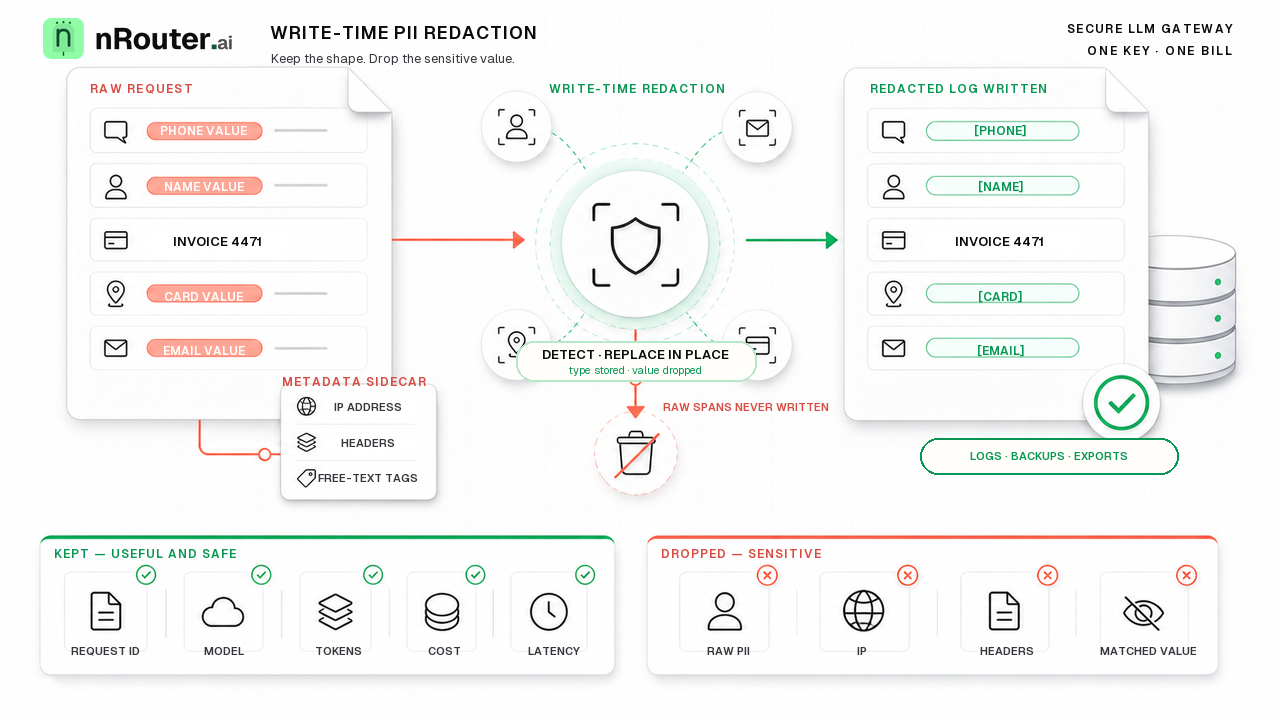
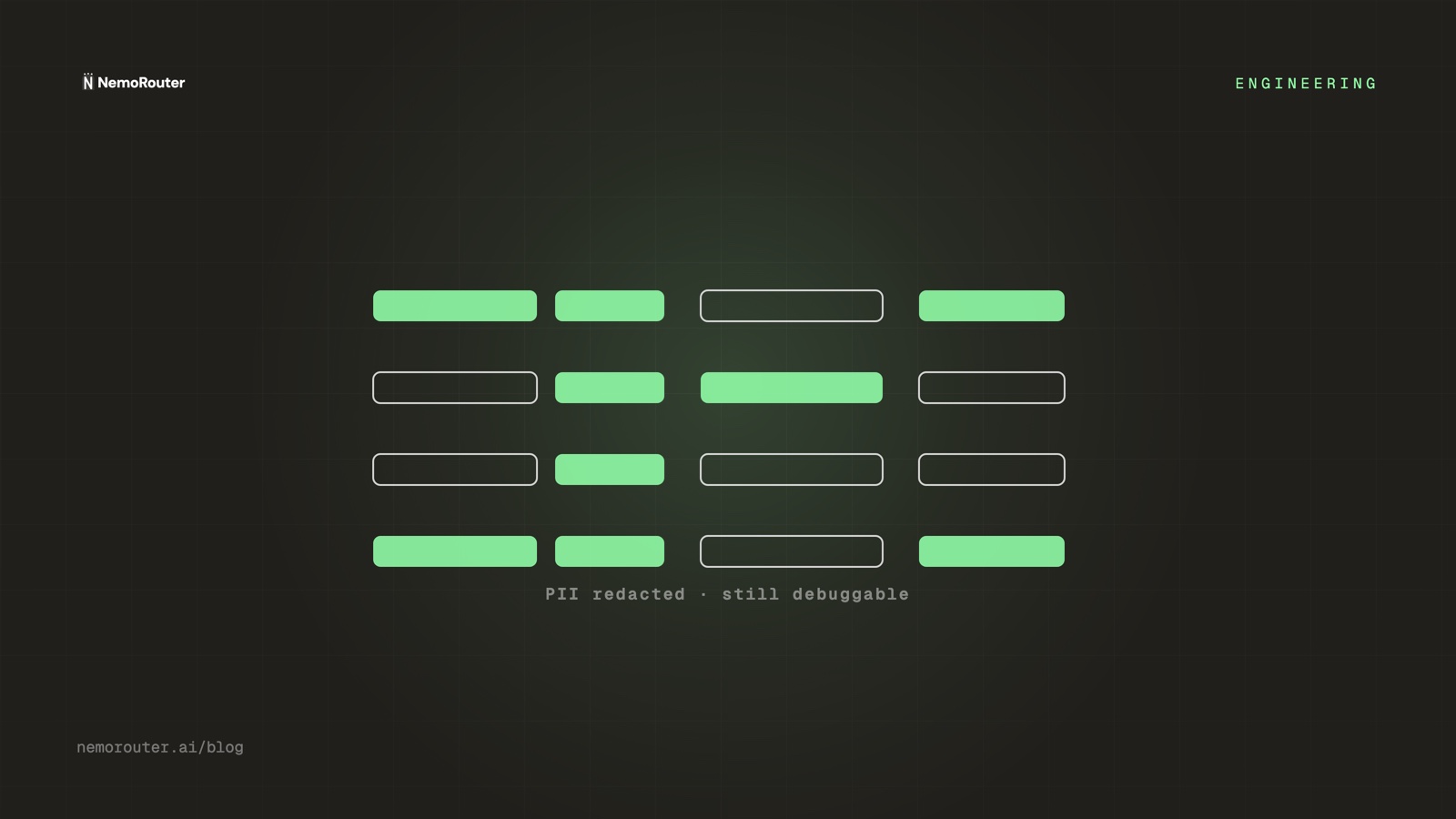
Figure 1: Write-time PII redaction architecture replacing sensitive identifiers with typed tokens prior to log persistence.
The mechanism: redact at the write, preserve the shape
Naive redaction destroys the log along with the risk. Replacing the whole message with [REDACTED] leaves a row that proves a request happened and tells you nothing else — which is how redaction programmes get rolled back six weeks in, when the first serious bug turns out to be uninvestigable.
Structure-preserving redaction replaces only the detected spans, in place, with a typed placeholder:
before  "Invoice 4471 charged my card 4111 1111 1111 1111 twice. I'm Dana
         Reed, dana.reed@example.com, +1 415 555 0132."

after   "Invoice 4471 charged my card [CARD] twice. I'm [NAME],
         [EMAIL], [PHONE]."
Read what survived. The invoice number 4471 is still there — it is not personal data, and it is the single most useful token in the message for finding the underlying bug. The sentence structure is intact, so you can see this was a billing complaint with contact details attached rather than, say, a password reset. The message ordering, the role, the token count and the model are all untouched.
Read what went. Four values that you have no business storing, and which would have propagated to every downstream copy.
The typing is the part people skip, and it is worth the extra work. [EMAIL] and [PHONE] tell you what kind of entity was in that position. That is frequently enough to reproduce a bug outright: if the failure is "the assistant mangles messages containing phone numbers", [PHONE] in the log is a complete diagnosis, and the actual number would have added nothing.
One detector, two exits
The same detection that powers request guardrails powers log redaction. The guardrail redacts before the prompt reaches the provider; the log policy redacts before it reaches your log store. Same entities, two different exits from the request path, and both have to be covered — a system that redacts one and not the other has moved the leak rather than closed it.
The metadata side door
You can redact the message bodies perfectly and still leak the same category of data through the field beside them. Request metadata routinely carries the requester's IP address, and an IP address is personal data in its own right under European law — the point was settled for dynamic IPs in Breyer and has been treated as settled ever since.
The pattern is depressingly consistent. A team spends a quarter building careful body redaction, ships it, passes review — and the requester IP goes to the log store untouched, in a metadata field one key away from the message they worked so hard to scrub. The same applies to identifying request headers, user-agent strings precise enough to fingerprint, and any customer-supplied tag that someone helpfully populated with an email address because it made their dashboard easier to read.
The fix is a category decision, not a field-by-field patch: treat metadata as content for redaction purposes. It goes through the same write-time pass, under the same policy, with identifying values stripped for non-privileged readers. Redaction is only complete when every copy of the value is handled — body, headers, and the metadata sidecar.
This is also the reason to be careful with custom attribution tags. Tags are enormously useful for attributing spend by team, customer and feature, and they are also a free-text field that someone will eventually fill with a customer's email address. Keep tags to stable identifiers you already hold rather than the human-readable string that names a person.
Worked example: the same ticket, three storage layers
Take the support request above and follow it into storage. Assume org-level redaction covering name, email, phone and card, with metadata scrubbing on.
| Layer | Content before | Content after |
|---|---|---|
| Request log body | Name, email, phone, card, invoice 4471 | [NAME] [EMAIL] [PHONE] [CARD], invoice 4471 |
| Request metadata | Requester IP, user agent, custom tags | IP stripped for non-privileged readers, tags kept |
| Guardrail event | — | pii-redaction fired, four spans, types only |
| Spend record | Model, tokens, cost, key, team | Unchanged — none of it is personal data |
Now run the two questions you actually ask a log store.
"Reproduce the Tuesday bug." You have the request id, the model, the message ordering, the invoice number, the token counts, the latency and the error. You can reconstruct a functionally identical request with synthetic values in about a minute. Nothing you needed was in the four redacted spans.
"How often does the card detector fire on the support key?" You count guardrail events by detector and scope. The answer is a number — say, 38 last week — and producing it required reading exactly zero card numbers. That is the shape of a metric you can put in front of a privacy review.
Edge cases we had to decide
-
When a detector fires, we log the event and never the match. "Redacted email
dana.reed@example.com" in an audit line has re-stored the exact value the redaction just removed, in a place that is often less protected than the request log. So the event carries detector, type, scope, action and request id — and nothing else. This is the single most common way a redaction programme quietly fails, and it fails while every dashboard says it is working. -
When redaction is uncertain, we redact. A string that looks like a national ID but might be an order number gets replaced. The cost of a false positive is a slightly less specific log line; the cost of a false negative is a stored identifier. Those are not symmetric, so the tie-break is not symmetric either.
-
When a value must be correlated across requests, we do not keep the value to do it. The correlation key is the request id and the key identity, both of which are already non-personal. Storing a hash of the original value "just for joins" is a re-identification surface with a friendly name, and we do not offer it as a shortcut.
-
When redaction is disabled for a workload, the setting is org-scoped and visible. It is not a per-request flag, because a per-request flag means the least careful call site sets the policy for the whole organisation. Loosening happens once, in one place, where someone accountable can see it — the same argument that governs scoping keys, budgets and guardrails.
-
When logs are forwarded to a third-party sink, they leave already redacted. The redaction happens at the write, so a forwarded copy inherits it rather than needing its own policy. If you ship request logs onward — the patterns are in Set Up LLM Log Callbacks: Datadog, Langfuse, S3, Slack — this is the property that keeps a second vendor from becoming a second copy of the problem.
What you see from the outside
Per request, the response headers carry the operational facts you need without carrying any content at all:
| Header | What it tells you |
|---|---|
x-nr-request-id | Always present; the id to quote in a ticket and to join a log row on |
x-nr-model | Which model actually served the call |
x-nr-request-cost | USD cost of the call — absent when the cost is not known |
x-nr-cost-status | exact or unpriced, so an absent cost is never read as a free call |
x-nr-request-cost is worth one explicit sentence, because it is the same honesty principle applied to money: when the cost is not known the header is absent, never 0. An absent header is a fact your code can branch on; a zero is an assertion that the call was free. The full argument is in Cost Honesty: We Read the Number, We Don't Invent It.
Which detectors fired is deliberately not a header. It is a field on the stored row, joined on that same x-nr-request-id — which puts "did redaction run" in the same place as "what was kept", the row you would have to open anyway.
And the shape of what is retained, side by side:
| Kept — useful and safe | Dropped — sensitive |
|---|---|
| Prompt structure with typed placeholders | Raw emails, phone numbers, national IDs, cards |
| Model, token counts, cost, latency | Requester IP for non-privileged readers |
| Status codes and error types | Identifying headers |
| Which detector fired, and where | The matched value itself |
| Request id, key identity, team | Free-text tags containing personal data |
That is a log you can debug with on Monday and hand to a privacy reviewer on Tuesday without rehearsing an explanation. The field-level reference is in Observability, the retention and access model in Audit log, and the detector configuration in Guardrails.
Limits
Detection is statistical, and no vendor's is perfect. Unusual formats, transliterated names and identifiers embedded in base64 blobs can pass. Write-time redaction reduces the volume and the durability of stored personal data by a large factor; it does not let you claim a log store contains none. Say the true thing in your data map.
Redaction is not anonymisation. A redacted log can still be re-identifiable in combination with other data you hold — timestamps plus a key identity plus a request id will often single out an individual session. Treat redacted logs as pseudonymised, with the access controls and retention limits that implies, and read the ICO's guidance on the data-protection principles before describing them as anonymous anywhere with legal weight.
You still need retention limits. Redaction reduces what a row contains; it does not answer how long you keep the row. Both decisions are required, and only one of them is an engineering problem.
What the provider receives is a separate question. Log redaction protects your store. Whether the prompt reaches a third-party model with the values intact is decided by the request-path guardrail, not by the log policy. They share detectors and are configured separately on purpose — see Inline LLM Guardrails on Every Request.
Try it
Send a request containing an email address and keep the request id that comes back:
curl -i https://api.nrouter.ai/v1/chat/completions \
  -H "Authorization: Bearer $NROUTER_API_KEY" \
  -H "Content-Type: application/json" \
  -d '{
    "model": "claude-sonnet-4-5-20250929",
    "messages": [{"role":"user","content":"Reply to dana.reed@example.com about invoice 4471."}]
  }' | grep -i '^x-nr-'
Then open that request id in your dashboard and confirm what the stored row contains: which detector fired, the invoice number, the structure, the typed placeholder — and not the address. Configuration is under Guardrails; the retention and access model is in Audit log. Our posture and subprocessor detail live on Security and Trust.
Pay as you go starts at $5 — a $5 minimum credit purchase with the platform fee on top, no subscription, redaction on from the first call. → Get started. Privacy-review questions are welcome in the nRouter community.
See also
- Inline LLM Guardrails on Every Request — the same detectors on the other exit, stopping values before they reach a provider rather than a log store.
- What to Log (and Not Log) on an LLM Gateway — the field-by-field retention decisions that sit on top of the redaction policy here.
- Building a Tamper-Evident Audit Trail for Admin Actions — how to keep an append-only record of who changed a redaction policy, without the record becoming its own leak.
- A SOC 2 Checklist for LLM Gateways — where write-time redaction lands in the evidence an auditor asks for.
- Set Up LLM Log Callbacks: Datadog, Langfuse, S3, Slack — shipping already-redacted logs onward so a second vendor is not a second copy.
- Attribute LLM Spend by Team, Customer, and Feature — using stable identifiers as tags rather than the human-readable string that names a person.
- Security — the platform controls and subprocessor posture behind all of the above.
Sources
External standards and guidance referenced above. Verified 2026-08-23. If a linked page has moved and we have not refreshed, email hello@nrouter.ai and we will re-check.
- GDPR Article 4, definition of personal data: gdpr-info.eu/art-4-gdpr
- GDPR Article 32, security of processing: gdpr-info.eu/art-32-gdpr
- ICO, guide to the data-protection principles: ico.org.uk
- NIST SP 800-122, guide to protecting the confidentiality of PII: csrc.nist.gov
- OWASP Top 10 A09, security logging and monitoring failures: owasp.org
- CJEU C-582/14 (Breyer), dynamic IP addresses as personal data: curia.europa.eu