

Pay as you go or a subscription: which LLM gateway plan is cheaper?
Every nRouter plan pays the same 4% platform fee on credits, so a subscription never lowers the fee. What Starter, Pro and Max buy is a monthly nrouter/auto usage allowance and higher rate limits — worth it only for traffic you are happy to let nRouter route.

Updated 2026-09-15: this post previously described a legacy Pro plan with a 0% fee, which is no longer sold.
The Direct Answer: On nRouter, paid subscriptions (Starter $20/mo, Pro $50/mo, Max $200/mo) do not lower the flat 4% platform fee on credit purchases—every tier pays the exact same 4% fee on top. Instead, subscriptions deliver high-leverage monthly allowances for smart model routing ($60/mo allowance on Starter, $100/mo on Pro, $400/mo on Max) alongside scaled throughput ceilings (up to 1,200 RPM). If your traffic uses named models exclusively, Pay-As-You-Go is mathematically cheaper.
This article focuses on nRouter pricing in production, including the practical trade-offs around LLM gateway.
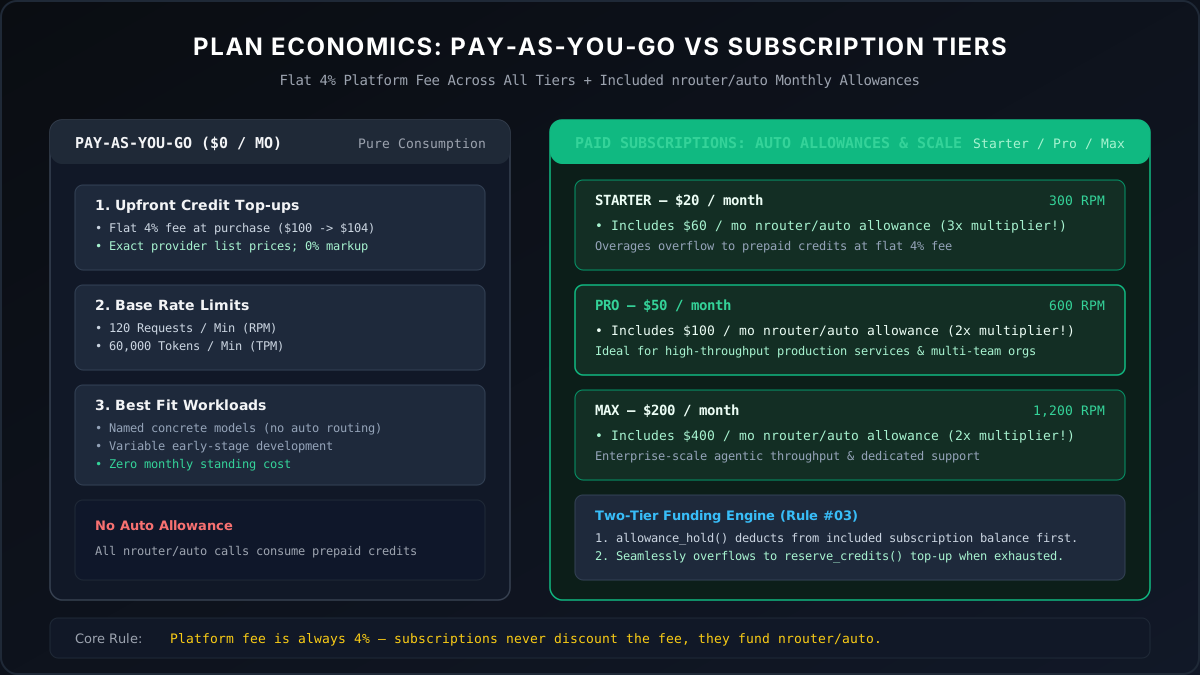
Figure 1: Plan Economics Comparison — The flat 4% platform fee invariant across all plans, paired with 2x–3x included smart-routing allowances on subscription tiers.
The fee does not decide it. Every self-serve plan pays the same platform fee: 4% of the credits you buy, charged on top, with no minimum fee. So a subscription is never cheaper because of the fee. It is cheaper when you would use its monthly
nrouter/autoallowance — Starter $20/mo includes $60 a month ofnrouter/autousage, Pro $50 includes $100, Max $200 includes $400, at list rate — or when you need its higher rate limits.
Every LLM-gateway pricing page has the same shape: a pay-as-you-go plan with a percentage fee, a few paid plans with a monthly price, and a "contact sales" door. The reflex is to look for the spend level where a subscription "pays for itself" by removing the fee. On nRouter that line does not exist, and it is worth knowing why before you go looking for it.
This post answers the reader question the old version of it answered wrongly:
pay as you go or a subscription — which is cheaper? The honest answer has
two parts. The platform fee is identical on every plan, so it cancels out of
the comparison. What is left is the monthly usage allowance for nrouter/auto
— the model name that tells nRouter to pick the model for you — and the higher
rate limits that come with a subscription. If you will not send traffic to
nrouter/auto and you do not need the higher limits, pay as you go is the
cheaper plan, full stop.
Five-minute path: the plans in one table, what a subscription buys, the worked example.
The plans in one table
Source of truth is the pricing page. No invented numbers: the anchor copy is "4% of your credits on every plan, charged on top, no minimum fee".
| Plan | Price | Platform fee | Monthly nrouter/auto allowance | Rate limits |
|---|---|---|---|---|
| Pay as you go | $0/month, $5 minimum credit purchase | 4% of the credits, on top | None | Pay-as-you-go limits |
| Starter | $20/month | 4% on credit top-ups | $60 of usage, at list rate | Higher |
| Pro | $50/month | 4% on credit top-ups | $100 of usage, at list rate | Higher |
| Max | $200/month | 4% on credit top-ups | $400 of usage, at list rate | Higher |
| Enterprise | Custom | Custom terms | Custom | Custom |
The subscriptions are monthly only. The current rate-limit numbers for each plan are on /pricing; this post does not restate them, because a limit copied into a blog post is a limit that drifts.
The feature set is identical across every row. No plan unlocks guardrails, A/B
routing, prompt management, evals, per-team budgets, multi-tenancy or virtual
keys — those ship on pay as you go the moment you sign up. The reasoning is in
every feature on every plan.
What varies is exactly two things: the monthly nrouter/auto allowance and the
rate limits. The fee is not on that list.
The fee is the same 4% on every plan
The platform fee is taken of the credits, and it is added on top so the credits land in full. The customer keeps 100% of the credits bought. That makes the arithmetic exact on every plan:
charge = credits × 1.04

$5 of credits    →  $5.20 charged   (the $5 minimum)
$100 of credits  →  $104.00 charged
$800 of credits  →  $832.00 charged
A credit top-up on Starter, Pro or Max pays the same 4%. There is no plan on which the fee drops, and no spend level at which a subscription "pays for itself" by removing it. Why the fee sits on top of a purchase rather than inside the per-token rate is covered in markup-free LLM credits.
If you arrived here from an older link, this is what changed:
| What the old version of this post said | What is true now |
|---|---|
| Pay as you go 4%, Pro 0% | 4% of the credits on every self-serve plan |
| Pro at $50/month or $500/year | Pro at $50/month, monthly only; the annual plan is not sold |
| Pro pays for itself above a spend breakeven | No fee breakeven exists; a subscription buys an allowance and higher limits |
| Choose a plan by your total monthly spend | Choose a plan by how much traffic you would send to nrouter/auto |
The legacy plan the old post described is no longer sold to new customers. Any saving computed from a 0% fee — including the breakeven tables that used to sit here — no longer applies to a plan you can buy.
What a subscription buys
A subscription includes a monthly usage allowance, and the allowance applies
to one model name only: nrouter/auto. When a request sends
model: "nrouter/auto", nRouter picks the model that serves it, and that usage
counts against the allowance, measured at list rate. When a request names a
model itself, it is paid from pay-as-you-go credits at list rate, with the same
4% fee on the credits — on every plan, subscription or not.
Two requests, side by side:
# Counts against a subscription's monthly nrouter/auto allowance
curl https://api.nrouter.ai/v1/chat/completions \
  -H "Authorization: Bearer $NROUTER_API_KEY" \
  -H "Content-Type: application/json" \
  -d '{"model": "nrouter/auto", "messages": [{"role": "user", "content": "Summarize this ticket."}]}'

# Names a model: paid from credits at list rate on every plan
curl https://api.nrouter.ai/v1/chat/completions \
  -H "Authorization: Bearer $NROUTER_API_KEY" \
  -H "Content-Type: application/json" \
  -d '{"model": "<a model id from /models>", "messages": [{"role": "user", "content": "Summarize this ticket."}]}'
The allowance relative to the price, per plan:
| Plan | Price | Allowance | Allowance ÷ price |
|---|---|---|---|
| Starter | $20/mo | $60 | 3× |
| Pro | $50/mo | $100 | 2× |
| Max | $200/mo | $400 | 2× |
It is a usage allowance, not a credit balance: it covers nrouter/auto
requests and nothing else, and it never turns into credits for a named model.
The trade you are making is control for price — you stop choosing the model for
that slice of traffic. For which tasks tolerate that and which do not, see
cost-vs-quality LLM routing.
When the allowance makes a subscription cheaper
Because the fee is identical everywhere, the comparison reduces to one
question: would the plan's price buy you more nrouter/auto usage than the
same money spent as credits? Three steps:
- Split your traffic. Mark each workload as pinned (it must run on a specific model — a production feature, an eval baseline, a regulated flow) or flexible (you are content for nRouter to choose — summaries, triage, drafts, internal tools).
- Price the flexible slice at list rate. Take last month's usage for those workloads from your spend ledger — reading a credit ledger shows where the per-request cost sits — and total it.
- Compare against the plan price. Pinned traffic costs the same on every plan, so ignore it. If the flexible slice at list rate is worth more than the plan's price and fits inside its allowance, the subscription is cheaper.
The reference points, all from the table above:
| Flexible usage at list rate | Paid from credits on pay as you go | Covered by a subscription |
|---|---|---|
| $60/month | $62.40 charged | Starter, $20/month |
| $100/month | $104.00 charged | Pro, $50/month |
| $400/month | $416.00 charged | Max, $200/month |
Read the table as a ceiling, not a promise. It assumes the flexible slice is worth the same at list rate whichever model serves it, and it assumes the usage stays inside the allowance. If your flexible slice is small — a few dollars a month — pay as you go is cheaper, because even Starter's $20 is more than the credits you would have bought.
Worked example — one team, four plans
A real-shaped scenario, anonymized as acct_b3c1. A product team spends
$800/month at list rate on pinned traffic: a customer-facing feature that
must run on the model it was evaluated against. It also runs an internal
ticket-triage job that does not care which model answers, worth about
$50/month at list rate.
The pinned traffic costs the same on every plan:
- $800 of credits, plus the 4% fee on top: $832.00/month
- Platform fee inside that: $32.00, identical on pay as you go, Starter, Pro and Max
The whole bill, plan by plan:
| Plan | Subscription | Pinned traffic | Triage job | Monthly total |
|---|---|---|---|---|
| Pay as you go | $0 | $832.00 | $52.00 from credits | $884.00 |
| Starter | $20 | $832.00 | inside the $60 allowance | $852.00 |
| Pro | $50 | $832.00 | inside the $100 allowance | $882.00 |
| Max | $200 | $832.00 | inside the $400 allowance | $1,032.00 |
For this team Starter is the cheapest plan, $32/month under pay as you go, because the triage job fits inside its $60 allowance. Pro buys allowance headroom it does not use, and is worth it only if the team needs the rate limits that come with it — compare them on /pricing. Max costs more than every other option at this volume.
Three things this example does not claim:
- It does not lower the fee. The $32 fee on the pinned $800 is the same on all four rows. The saving comes entirely from moving the triage job into the allowance.
- It does not assume the triage job gets the same model. On
nrouter/autonRouter picks the model; the comparison holds only if the team is content with that for triage. If it is not, the triage job is pinned traffic and pay as you go wins. - It is not a promo. The prices and allowances are the ones on /pricing, which is the contract. The spend-reduction levers that sit outside the plan choice are in cutting LLM costs.
When to stay on pay as you go — three operational guards
We would rather you stay on pay as you go than subscribe against the wrong shape. Three cases where a subscription is the wrong choice even when the worked example above looks like yours:
-
Everything you send is pinned. If every workload names its model — an agent pipeline that picks a model per step, a product feature under an eval, a regulated flow — the allowance covers none of it. You would pay the subscription price and the same credits plus fee on top. Stay on pay as you go and put the controls in credits, budgets, rate limits, guardrails instead.
-
Your flexible slice is spiky. If the triage-style workload was worth $10 one month and $90 the next, the average can clear Starter's $20 while the trough does not. Measure a few months first; the plan is monthly, so the decision is easy to revisit.
-
You are buying for rate limits you have not hit. Higher limits are the other thing a subscription buys, and they are worth paying for only once you are actually meeting a limit. Budgets and rate limits solve different problems — budgets vs rate limits covers which one you are short of — and the per-key mechanics are in RPM and TPM rate limiting.
It is also worth being precise about what cancelling a subscription does, because the payments machinery is the same everywhere. Cancelling ends a subscription going forward — Stripe's subscription cancellation docs describe the default as stopping future invoices, not unwinding past ones. Money already taken comes back only as a refund, which is a separate reversal issued against the original charge rather than an undo of it. Read the terms on /pricing before you subscribe, and ask the same question of every vendor you are comparing.
If none of those three guards trip, the math is clear. The signup form is app.nrouter.ai/signup; plans are on /pricing.
Switching cost: one model string
Moving from pay as you go to a subscription is a billing change, not an integration change. Same base URL, same API keys, same SDK, same routing config. The two-line OpenAI / Anthropic SDK diff covered in the buyer's guide is migration into nRouter from another gateway; moving between nRouter plans does not touch your code at all.
The one change that decides whether a subscription saves money is in your
request, not your bill: the flexible workloads have to send
model: "nrouter/auto". A team that subscribes and keeps naming models in
every request has bought an allowance it never draws on. So the switch has
two steps:
- Pick the plan on /pricing.
- Change the
modelfield tonrouter/autofor the flexible workloads only, and leave the pinned ones exactly as they are.
The 90-second decision
Three numbers from your own ledger:
- Last month's pinned spend. Everything that must run on a named model. This costs the same on every plan, so it only tells you what you will pay regardless.
- Last month's flexible spend at list rate. Everything you would let nRouter route.
- Compare the flexible figure with the plan table above.
If the flexible figure is under $20/month: pay as you go is correct, no decision to make.
If it is between $20 and $60/month: Starter covers it for $20, provided you are content for nRouter to pick the model for that slice.
If it is above $60/month: compare Pro's $100 allowance for $50 and Max's $400 for $200 against what you would have bought as credits, and weigh the higher rate limits if you are already meeting a limit. Enterprise is the conversation when you need custom terms — contact sales.
If you would rather we run the exercise against your invoices, that is what the 30-minute walk-through on /community is for — bring the last 90 days. We will not pitch you a subscription if the math says pay as you go; the audit cuts both ways.
Try it on your own numbers
Pay as you go from $5, platform fee on top. A card is required, the $5 minimum is a real charge, and there is no free tier. That is enough to exercise routing, guardrails, A/B tests and per-team budgets on real traffic, and to measure your pinned and flexible slices before any subscription.
→ Get started at app.nrouter.ai/signup — Pay as you go from $5, with the platform fee on top. No subscription. Already know your flexible slice clears $20/month? Pick a plan on /pricing. Mid-market SaaS or larger? Bring 90 days of invoices to a 30-min walk-through (book through /community).
See also
- OpenRouter alternative: every enterprise LLM-gateway feature, on every plan — how the same 4% fee compares with a flat card-purchase fee on another gateway.
- Cutting LLM costs: what published discounts actually save, and where the model is an assumption — the spend-reduction levers to pull before you change plan, separated into published discounts and assumptions.
- LLM gateway buyer's guide 2026 — the buyer-stage taxonomy, including where plan choice sits in the decision.
- Credits, budgets, rate limits, guardrails: four pre-flight gates — the controls that keep a plan change from turning into a surprise bill.
- How to read your LLM credit ledger — how to split last month's spend into pinned and flexible slices before you choose.
- Every feature on every plan: we charge a fee, not a gate — why a plan changes the allowance and the rate limits, and nothing else.
- /pricing — the canonical plan table these figures come from.
Sources
Verified 2026-09-15. If a linked page has moved or changed a number since, email hello@nrouter.ai and we will re-audit and re-date this section.
Provider list rates — the published per-token prices that credits and the
nrouter/auto allowance are measured against, which belong to each provider
and not to nRouter:
- Anthropic API pricing: claude.com/pricing
- Azure OpenAI Service pricing: azure.microsoft.com/en-us/pricing/details/azure-openai/
- AWS Bedrock pricing: aws.amazon.com/bedrock/pricing/
Payment mechanics — cited for the third operational guard, where the difference between ending a subscription and getting money back matters:
- Stripe — cancelling a subscription: docs.stripe.com/billing/subscriptions/cancel — cancellation stops future invoices; it does not reverse settled ones.
- Stripe — refunds: docs.stripe.com/refunds — a refund is a reversal issued against an existing charge, with its own lifecycle and its own timing.
nRouter's own plan figures come from /pricing, which is authoritative over any number restated here. Anthropic, Microsoft, AWS and Stripe are trademarks of their respective owners; nRouter is not affiliated with or endorsed by them.
Frequently asked questions
How does nRouter pricing address plans in one table?
Source of truth is the pricing page. No invented numbers: the anchor copy is "4% of your credits on every plan, charged on top, no minimum fee".
How does nRouter pricing address fee is the same 4% on every plan?
The platform fee is taken of the *credits*, and it is added on top so the credits land in full. The customer keeps 100% of the credits bought.
What should teams know about a subscription buys?
A subscription includes a monthly usage allowance, and the allowance applies to one model name only: nrouter/auto. When a request sends model: "nrouter/auto", nRouter picks the model that serves it, and that usage counts against the allowance, measured at list rate.

The team building nRouter.