

Two Ways to Ask for a Model: Direct, or nrouter/auto
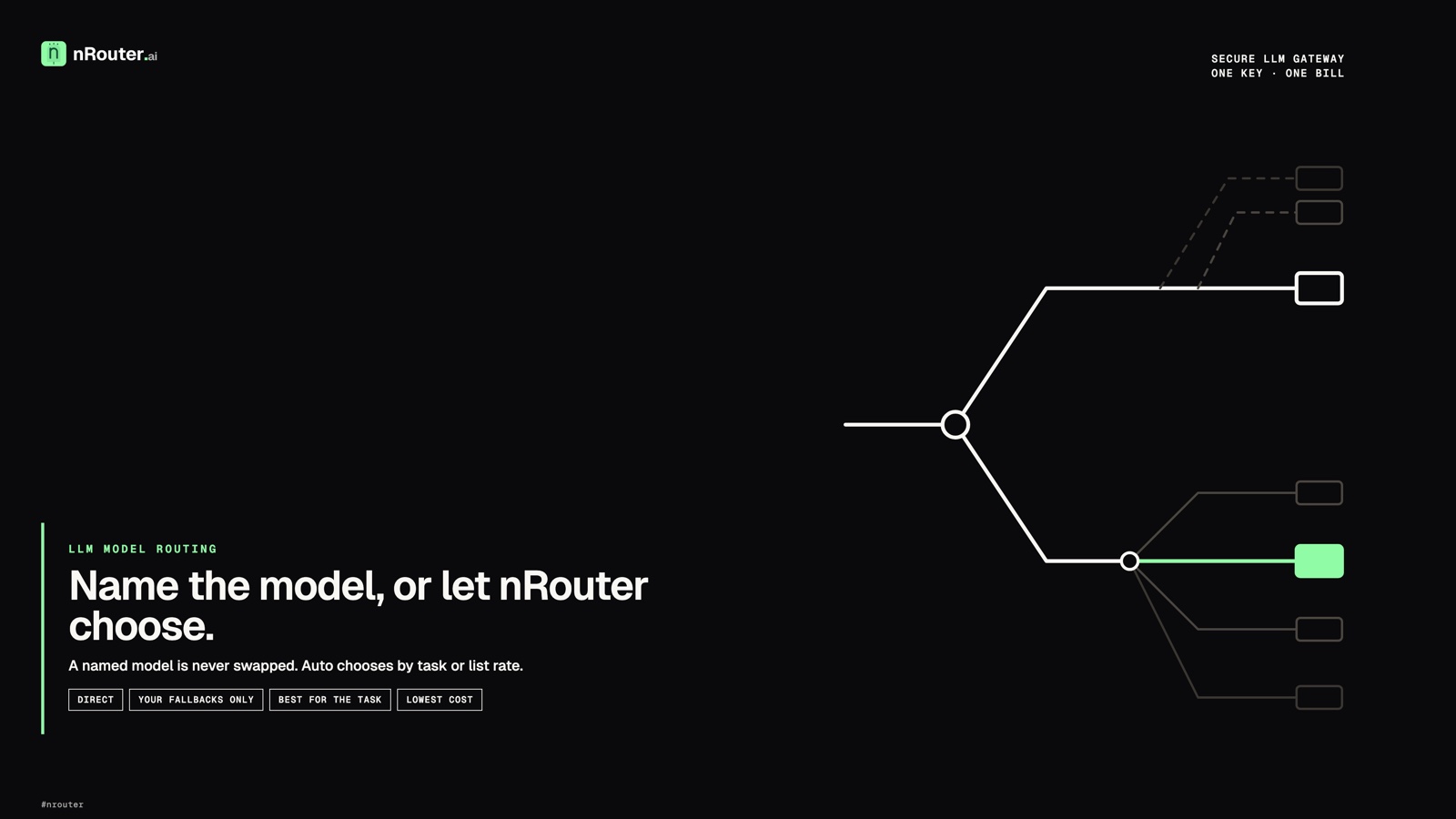
nRouter gives you two ways to ask for a model. Name one and it is never swapped, except through a fallback you configured. Send nrouter/auto and nRouter chooses, by Best for the task or Lowest cost.
What it does
There are two ways to ask nRouter for a model. Direct: put a model name in
modeland that model is called; nRouter never swaps it, and a different model answers only through a fallback you configured yourself. nrouter/auto: putnrouter/autoinmodeland nRouter chooses an eligible model, by Best for the task or Lowest cost.
The model string you send is the whole switch. A catalogue name such as gpt-5.4-mini is a Direct request; nrouter/auto is the other way. There is no routing header to set and no third mode. Either way you pay the served model's list price with a 0% platform fee, and the response's x-nr-model header names the model that answered.
Setup steps live in the routing quick start; the full reference is Router Settings.
The job it does for you
Most teams arrive with one of two needs, and they pull in opposite directions.
| You want | Ask for it this way | What nRouter promises |
|---|---|---|
| A specific model, every time (evals, regulated flows, a prompt tuned to one model) | Direct: "model": "claude-sonnet-4-5" | That model is called. No silent substitution, ever. |
| Survive a provider outage on a named model | Direct plus your own fallback list | The next model you listed answers, only when the provider cannot take the request. |
| A sensible model without picking one | "model": "nrouter/auto", Best for the task | Smart model selection chooses an eligible model for the task. |
| The lowest list rate among models fit for the task | "model": "nrouter/auto", Lowest cost | Models fit for the task are ordered by list rate and the first serves. |
Before, teams wrote both behaviours in application code: a retry wrapper that swapped models on any error, and a hand-kept table of "cheap" and "good" models. The wrapper retried where the provider had already billed work; the table went stale with the next price change.
After, the decision lives in one string. Code that must pin a model names it; code that wants a choice sends nrouter/auto. Failover rules and price data are the gateway's job, and response headers tell you what happened.
Two things changed on 2026-10-15 that make this the whole picture. Smart Router aliases with their own strategy were withdrawn, so an alias name is now an unknown model, and per-model weights are no longer applied. Fallback lists you saved for a model keep working.
How it works
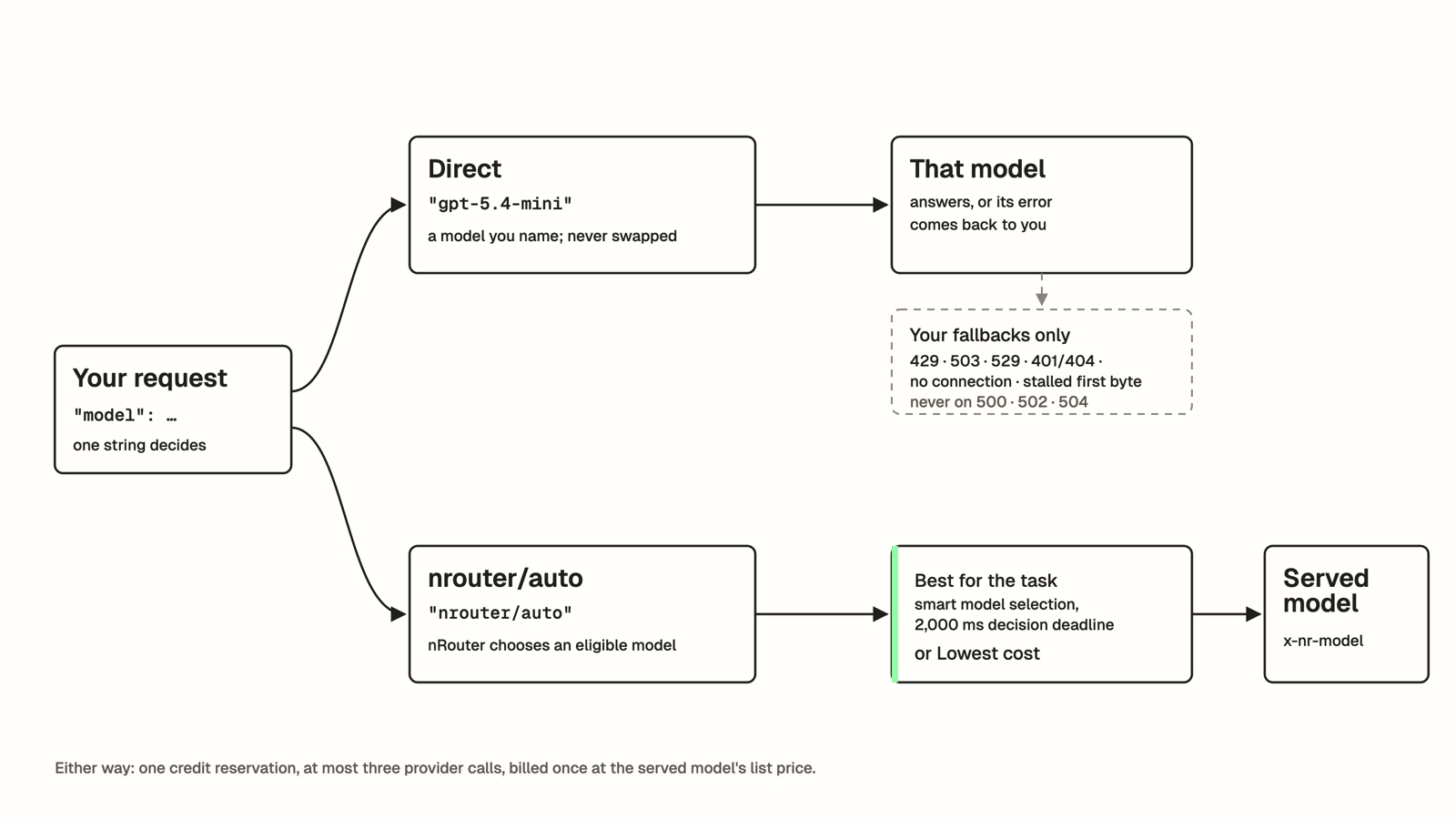
Figure 1: The model string selects the path. Direct calls the model you named; nrouter/auto chooses one.
Direct: the model you name is the model you get
When model names a catalogue model, that model is called. A different model can answer only through a fallback you set up:
- A saved fallback list for that model, kept on the Direct tab of Router Settings, or
nrouter_fallbackson the request, up to four model names, which replaces the saved list for that one call.
Even then, the next model is tried only when the provider cannot take the request:
| Provider outcome | Fails over to your next model? |
|---|---|
429, 503, Anthropic 529 | Yes |
401 or 404 from a misconfigured provider deployment | Yes |
| Connection never opened | Yes |
| No first byte in time (a stalled provider) | Yes |
500, 502, 504 | No, returned to you |
| Read timeout after the connection opened | No, returned to you |
The line is drawn where a retry does not risk a second bill to you. A refusal before any work (429, 503, 529, a deployment fault) and a connection that never opened cannot have been billed. A stalled first byte is the one case where the provider may already have started: the gateway abandons that call and nRouter absorbs whatever it cost, so you are still charged once, for the model that answered. Once response bytes have arrived, or on a 500, 502, 504 or read timeout, the request is never replayed on another model. One request takes one credit reservation and one rate-limit slot and makes at most three provider calls however far it walks.
nrouter/auto: nRouter chooses
Send nrouter/auto and nRouter chooses an eligible model from the ones your organization, team and key allow. Requests that ask for reasoning, carry a long input, or run a long tool conversation are treated as heavy and offered heavy models only. The choice follows your organization's preference:
| Preference | How the model is chosen |
|---|---|
| Best for the task (default) | Smart model selection chooses the model for the task, under a 2,000 ms decision deadline. With no accepted answer in time, the reviewed default for the request's tier serves it. |
| Lowest cost | Orders the models fit for the task by the lowest list rate: input plus output price per million tokens, weighted equally, read live from the catalogue. The first serves; up to two more of the same tier are its fallbacks. |
The 2,000 ms figure bounds the decision step. It is not a promise about how fast your response arrives.
Set it up
- Get a key. Create a virtual key in the dashboard and export it as
NROUTER_API_KEY. The base URL ishttps://api.nrouter.ai/v1, and any OpenAI-compatible SDK works. - Make a Direct call. Name the model you want:
curl -sD - https://api.nrouter.ai/v1/chat/completions \
  -H "Authorization: Bearer $NROUTER_API_KEY" \
  -H "Content-Type: application/json" \
  -d '{
    "model": "gpt-5.4-mini",
    "messages": [{ "role": "user", "content": "Summarize this incident report." }],
    "nrouter_fallbacks": ["claude-sonnet-4-5", "gpt-5.5"]
}'- Read the headers. A call answered by the model you named reads
x-nr-routing: direct. If the first fallback answered, it readsfallback:1, the 0-based index in the chain you walked.x-nr-attemptscounts provider calls andx-nr-modelnames the model that served it. - Save a standing list instead if every caller should share one. Owners and Organization Admins set a fallback list per model on the Direct tab of Router Settings; drop
nrouter_fallbacksfrom the request and the saved list applies. - Switch a call to nrouter/auto by changing one string:
import OpenAI from 'openai';

const client = new OpenAI({
  baseURL: 'https://api.nrouter.ai/v1',
  apiKey: process.env.NROUTER_API_KEY,
});

const { data, response } = await client.chat.completions
  .create({
    model: 'nrouter/auto',
    messages: [{ role: 'user', content: 'Summarize this incident report.' }],
  })
  .withResponse();

console.log(response.headers.get('x-nr-model')); // the model that answered
console.log(data.choices[0].message.content);- Pick the preference. Best for the task is the default. To use Lowest cost, an Owner or Organization Admin changes it on the nrouter/auto tab of Router Settings. It is an organization-wide setting; nothing in your code changes.
Do not send nrouter_fallbacks with nrouter/auto. It builds its own fallbacks, and the request is refused with 400 fallback_not_allowed.
Worked example with numbers
Lowest cost sorts on a simple figure: input price plus output price, per million tokens, weighted equally. The rates below are illustrative, not catalogue prices, so the arithmetic is easy to follow. Read the live rates on the models page.
| Model (illustrative) | Input $/M | Output $/M | Rate used for ordering | Order |
|---|---|---|---|---|
| Model A | 0.40 | 1.60 | 2.00 | 1st, serves |
| Model B | 0.25 | 2.00 | 2.25 | 2nd, fallback |
| Model C | 1.00 | 4.00 | 5.00 | 3rd, fallback |
Now cost one request that reads 10,000 tokens and writes 500, on each model:
| Model | Input cost | Output cost | Request cost |
|---|---|---|---|
| Model A | 10,000 × $0.40/M = $0.0040 | 500 × $1.60/M = $0.0008 | $0.0048 |
| Model B | 10,000 × $0.25/M = $0.0025 | 500 × $2.00/M = $0.0010 | $0.0035 |
| Model C | 10,000 × $1.00/M = $0.0100 | 500 × $4.00/M = $0.0020 | $0.0120 |
Model A serves because its list rate is lowest, yet Model B would have billed less for this read-heavy request. That is exactly why we describe Lowest cost as ordering by list rate and never as the smallest bill: the order is set before the gateway knows how many tokens you will read or write. For a write-heavy request the comparison flips the other way. If your traffic is reliably lopsided, name the model Direct.
What it costs
Both ways bill identically. Your organization's credit balance is charged the served model's list price, with a 0% platform fee and no per-token markup. Pay as you go starts at $5, and a purchase charges exactly the credits bought; the details are on pricing.
- Direct with fallbacks. You pay for the model that answered, once. A fallback model can cost more or less than the one you named.
- nrouter/auto. You pay the list price of the model it chose, reported on
x-nr-request-cost. A fallback can cost more than the first pick. - Refusals. A request refused before any provider call, such as one rejected with
fallback_not_allowed, is not charged.
Markup-Free LLM Credits: 0% Platform Fee, Exact List Price walks through the fee arithmetic line by line.
Where it fits with the rest of the platform
Routing decides which model answers; the rest of the request path is unchanged by the choice.
| Capability | How it interacts with the two ways |
|---|---|
| Budgets and rate limits | One credit reservation and one rate-limit slot per request, however many fallbacks it walks |
| Model allowlists | nrouter/auto chooses only inside the org, team and key allowlists; it never widens them |
| Response cache | An identical non-streaming request can be answered from a short-lived cache; x-nr-routing is absent on a hit |
| Request logs | Each request records the served model and routing outcome |
For failover in depth, Provider Fallback Chains: Surviving an OpenAI Outage shows a chain riding out a real outage. 429 vs 402 on an LLM Gateway: Which to Retry, Which to Stop covers what your own client should do with the errors that come back. The hold behind "one reservation per request" is explained in Reserve-and-Settle: Never Overspend a Credit Balance.
Organizations that need these controls under dedicated tenancy or in their own cloud can talk to us about nRouter Enterprise.
Limits and what it will not do
- Direct never improves your choice. If the model you named is slow or wrong for the task, nRouter still calls it. Choosing is what
nrouter/autois for. - No failover on
500,502,504or a read timeout. These come back to you, because the provider may already have done billable work. - At most three provider calls per request, and at most four names in
nrouter_fallbacks. Every target must be a model your key can already route to; one it cannot is refused by name, never dropped. nrouter/autotakes no per-request fallback list. It refusesnrouter_fallbackswith400 fallback_not_allowed.- Lowest cost is not the lowest bill. It orders by list rate, as the worked example shows.
- The preference is organization-wide. A single request cannot ask for Lowest cost while the organization is on Best for the task.
- Smart model selection can be switched off. An Owner or Organization Admin can turn off Smart model selection under Settings → Privacy, after which the prompt is never sent to the decision step; Lowest cost keeps working, while Best for the task requests may be refused with a
400that names the setting. - Aliases are gone. A former Smart Router alias name now returns the unknown-model error; send a catalogue name or
nrouter/auto.
Frequently asked questions
What are the two ways to ask nRouter for a model?
Direct and nrouter/auto. Direct means you put a catalogue model name in model and that model is called; nRouter never swaps it, and another model answers only through a fallback you configured. nrouter/auto means nRouter chooses an eligible model by Best for the task (the default) or Lowest cost. Either way you pay the served model's list price.
When does a Direct request fail over to another model?
Only when you configured a fallback, as a saved list for that model or nrouter_fallbacks on the request, and only when the provider cannot take the request: a 429, 503 or 529, a 401 or 404 deployment fault, a connection that never opened, or a stalled first byte. A 500, 502, 504 or read timeout never fails over.
Does Lowest cost guarantee the smallest bill?
No. It orders the models fit for the task by the lowest list rate: input plus output price per million tokens, weighted equally, read live from the catalogue. It does not know your token counts in advance, so a read-heavy or write-heavy request can cost less on another model. You are billed the served model's list price.
How do I know which model answered?
Read the response headers. x-nr-model names the model that served the request. x-nr-routing reads direct when the first model in the chain answered and fallback:<n> when the entry at 0-based index n did. x-nr-attempts counts provider calls.
What happened to Smart Router aliases?
They were withdrawn on 2026-10-15. A request that names a former alias now returns the unknown-model error. Send a catalogue model name for Direct, or nrouter/auto to have nRouter choose. Fallback lists you saved for a model keep working.
Try it
Pay as you go starts at $5 with a 0% platform fee: create an account at app.nrouter.ai/signup, make one Direct call and one nrouter/auto call, and compare x-nr-model on the two responses. The routing quick start has the five-minute version, and nrouter.ai has the wider platform.
See also
- Provider Fallback Chains: Surviving an OpenAI Outage — a fallback list working through a real provider outage, the Direct path's safety net in practice.
- 429 vs 402 on an LLM Gateway: Which to Retry, Which to Stop — what your client should do with the errors the gateway hands back instead of failing over.
- Reserve-and-Settle: Never Overspend a Credit Balance — why a request that walks three models still takes one hold and one charge.
- Markup-Free LLM Credits: 0% Platform Fee, Exact List Price — the billing that applies identically to both ways of asking.
- Cost Honesty: Unpriced Is Never $0 on Your LLM Bill — why
nrouter/autonever chooses a model without a usable price. - Router Settings reference — every field on the Direct and nrouter/auto tabs.
Sources
Verified 2026-10-15. If something has drifted, email hello@nrouter.ai.
- HTTP 429 Too Many Requests: RFC 6585 §4
- HTTP 500, 502, 503 and 504 semantics: RFC 9110 §15.6
- Anthropic
529 overloaded_error: docs.anthropic.com/en/api/errors - OpenAI chat completions request shape: platform.openai.com/docs/api-reference/chat
- OpenAI Node SDK
withResponse()for headers: github.com/openai/openai-node
The team building nRouter.
More from Product
All posts →
LLM Observability: Traces, Spend Logs, and Request Debugging
Inspect end-to-end inference traces, exact-cent spend rows, and multi-provider routing decisions under one request ID, with response headers on every call.
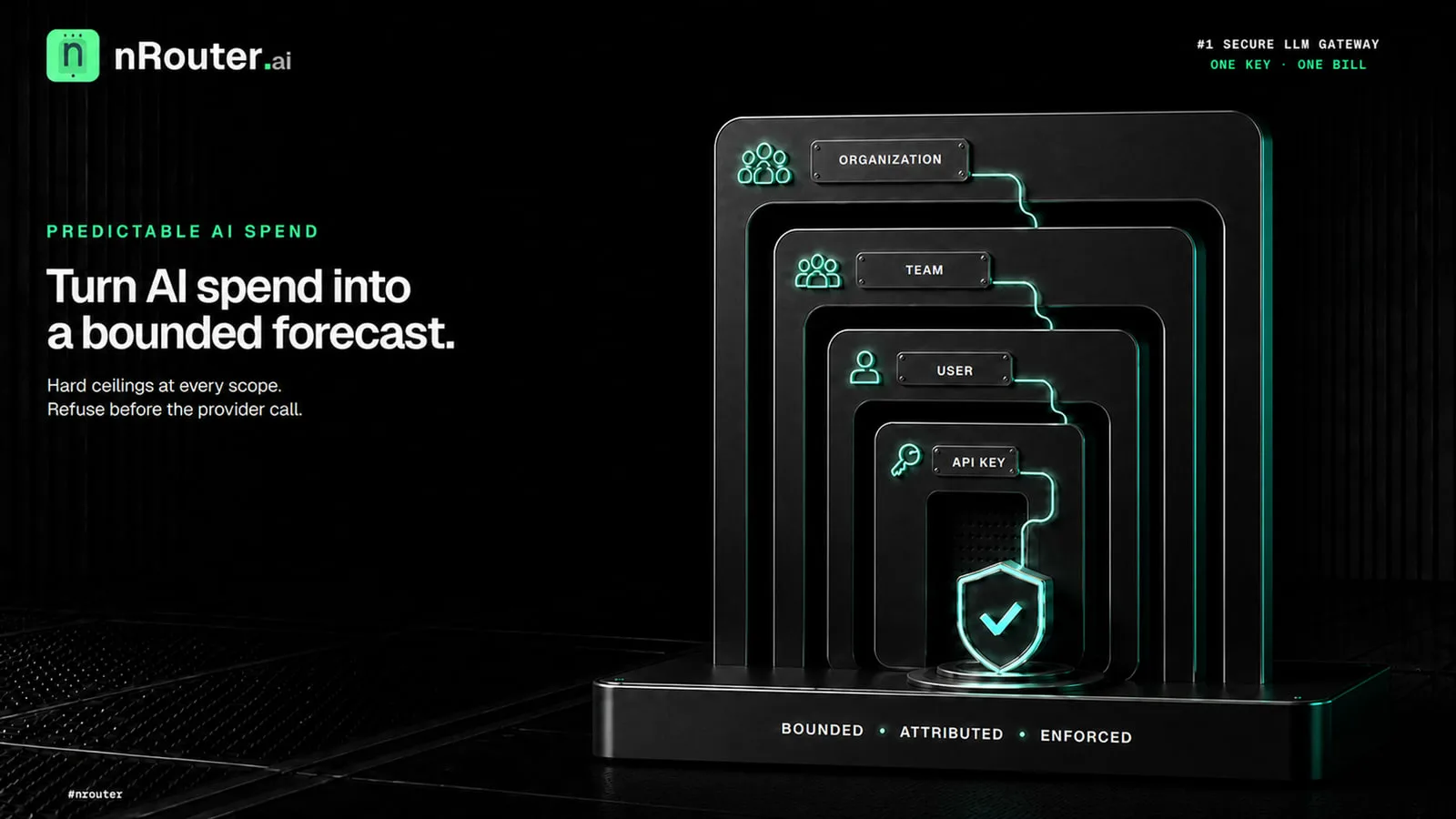
Budget Ceilings That Turn AI Spend Into a Forecast
A forecast is only a forecast if the worst case is bounded. Set hard dollar ceilings at the org, team, user and key scope, decompose next month's number into them, and know exactly which code your client gets when one bites.
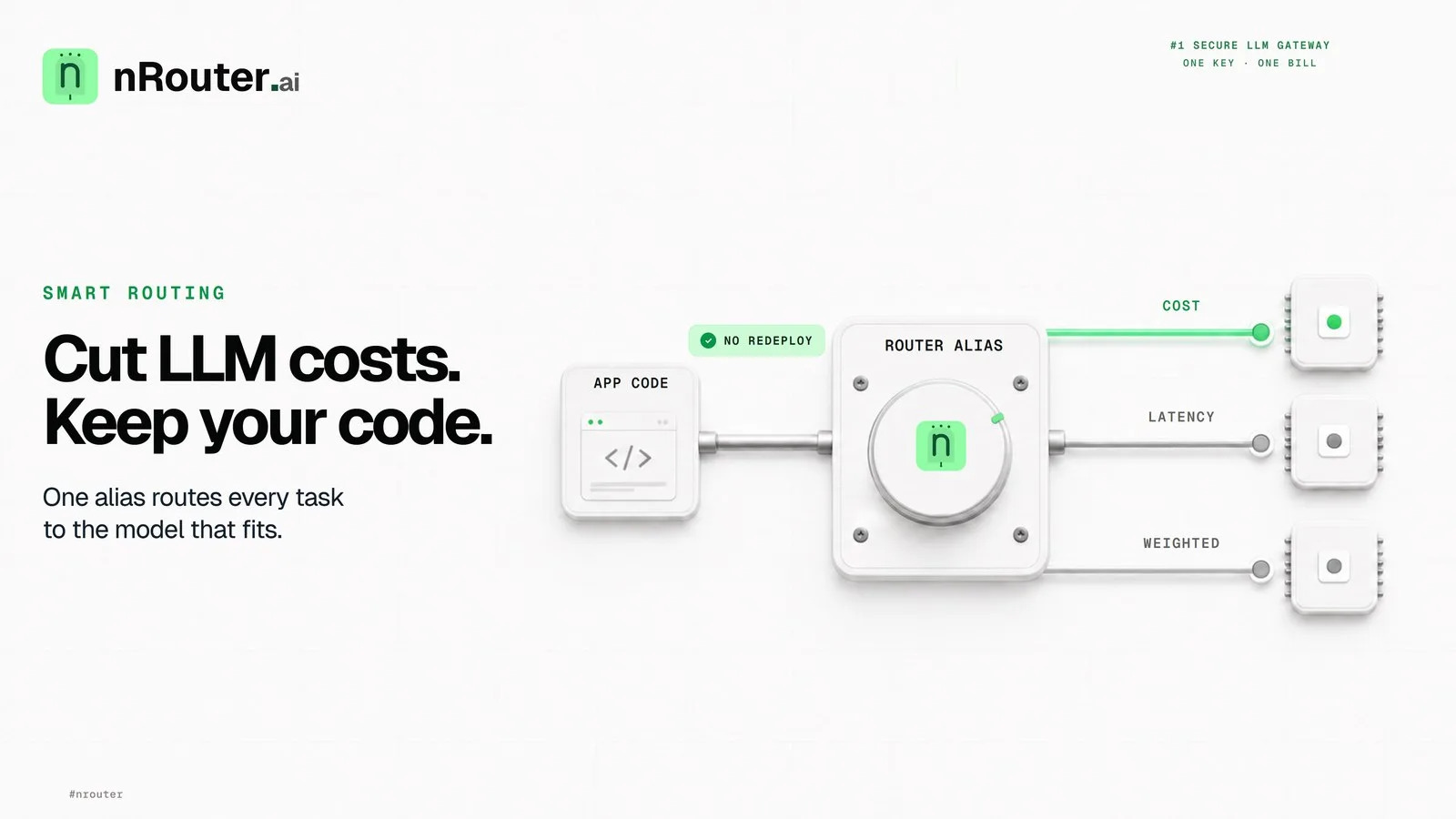
Cut LLM Costs by Routing, Not by Rewriting Your App
Routing is the one cost lever you can pull from a dashboard. Point an alias at a set of models, choose cost or latency or weighted, and change what a request costs without touching a line of application code.