

Enterprise Adoption Surges as nRouter Reaches SOC 2 Type II In-Progress Milestone and Launches Dedicated VPC Deployments
Accelerating enterprise adoption across fintech and digital health with institutional security, Postgres Row-Level Security isolation, and private VPC deployment options.
SUNNYVALE, CA, October 1, 2026 — nRouter, the enterprise AI routing and FinOps platform operated by CloudAct Inc., today announced significant enterprise customer adoption milestones across financial services, healthcare technology, and enterprise software sectors, alongside key security governance advancements.
Engineering teams deploy production workloads on nRouter to unify multi-provider AI access while maintaining rigorous data sovereignty, zero-leakage security boundaries, and institutional financial governance.
Key Enterprise Milestones
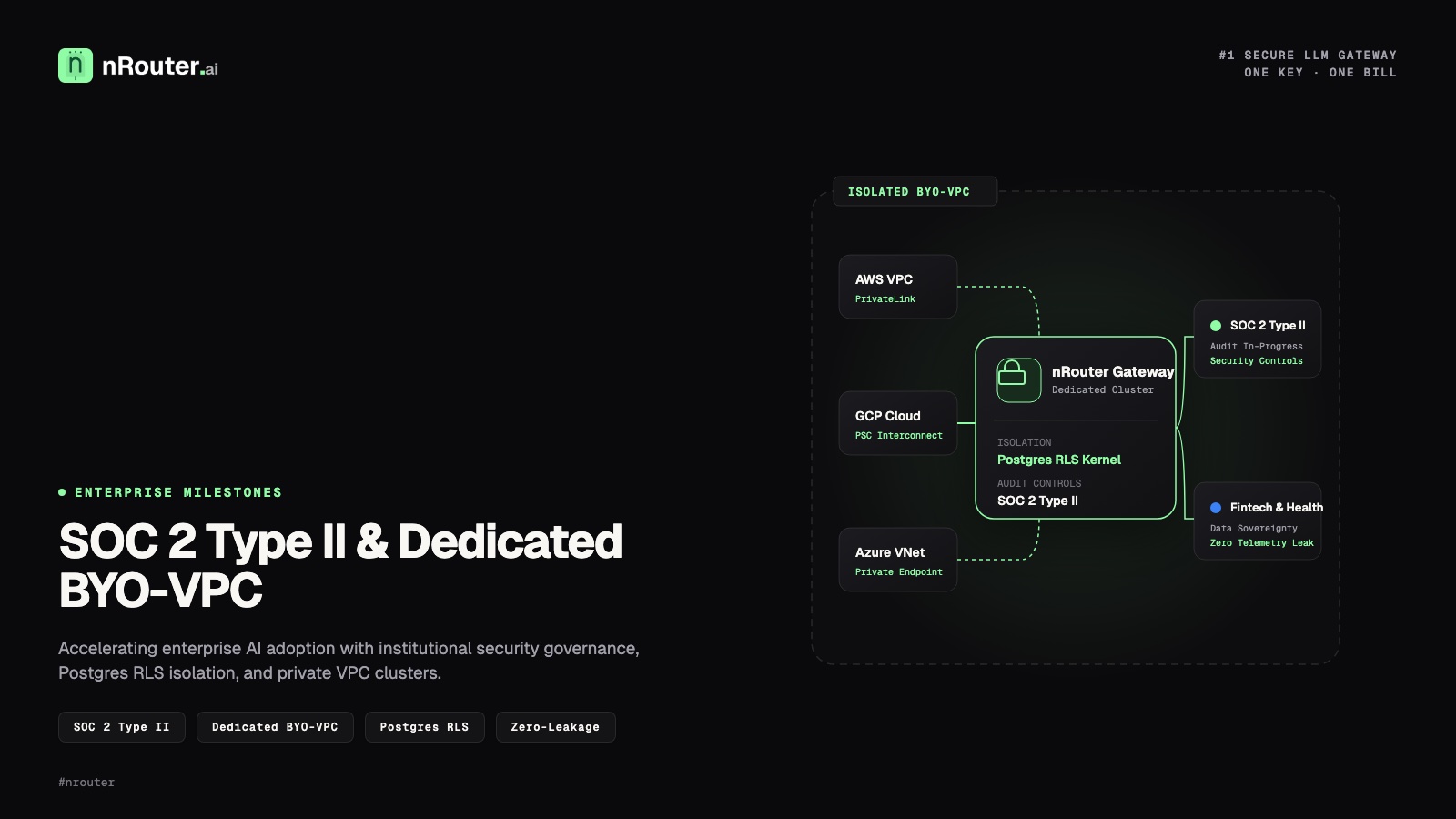
- SOC 2 Type II Audit In Progress: nRouter has achieved the formal readiness milestone for its SOC 2 Type II examination, validating security controls across infrastructure, key management, and data access.
- Dedicated BYO-VPC Deployments: Enterprises with strict regulatory constraints can now deploy nRouter gateway clusters directly within their own Amazon Web Services, Google Cloud Platform, or Microsoft Azure Virtual Private Clouds.
- Postgres Row-Level Security (RLS): True multi-tenant isolation enforced at the database kernel level, ensuring that organizational telemetry, virtual keys, and spend logs are mathematically segregated.
- Healthcare & Enterprise Readiness: Comprehensive Business Associate Agreements (BAAs) available for HIPAA-regulated healthcare applications, alongside full GDPR compliance.
Solving Enterprise Scale & Shadow AI
As hundreds of developers and autonomous agents within an enterprise begin invoking generative AI APIs independently, organizations face fragmented billing, lack of audit trails, and unpredictable cost escalations. nRouter acts as the central institutional data and control plane, providing:
- Dual-Axis RBAC: Fine-grained permissions across Organizations, Teams, and Virtual Keys.
- Immutable Audit Trails: Complete chronological records of administrative events, virtual key minting, and policy modifications.
- Hard Monthly Budgets: Enforced at the gateway layer, preventing runaway agent loops from exhausting department budgets.
Executive Reflection
"The conversation around enterprise generative AI has shifted permanently from 'Can we build a proof-of-concept?' to 'How do we govern, secure, and scale production AI safely?'" said Rama Surasani, Founder and CEO of nRouter. "By pairing our sub-millisecond Rust gateway with institutional security and dedicated VPC infrastructure, we give enterprise CISOs and CTOs the confidence to deploy mission-critical AI workloads at institutional scale."
Learn More About Enterprise Deployments
To learn more about nRouter's dedicated VPC architecture, custom SLAs, and enterprise security controls, visit nrouter.ai/enterprise.
For media inquiries: sales@nrouter.ai. For enterprise sales and architecture reviews: sales@nrouter.ai.
About nRouter
nRouter is a managed LLM gateway for teams that want one key, one bill, and zero provider configuration. Customers buy credits, call any major model through a single endpoint, and get cost tracking, routing, and safety controls built in. nRouter is built and operated by CloudAct Inc..
More from the press room
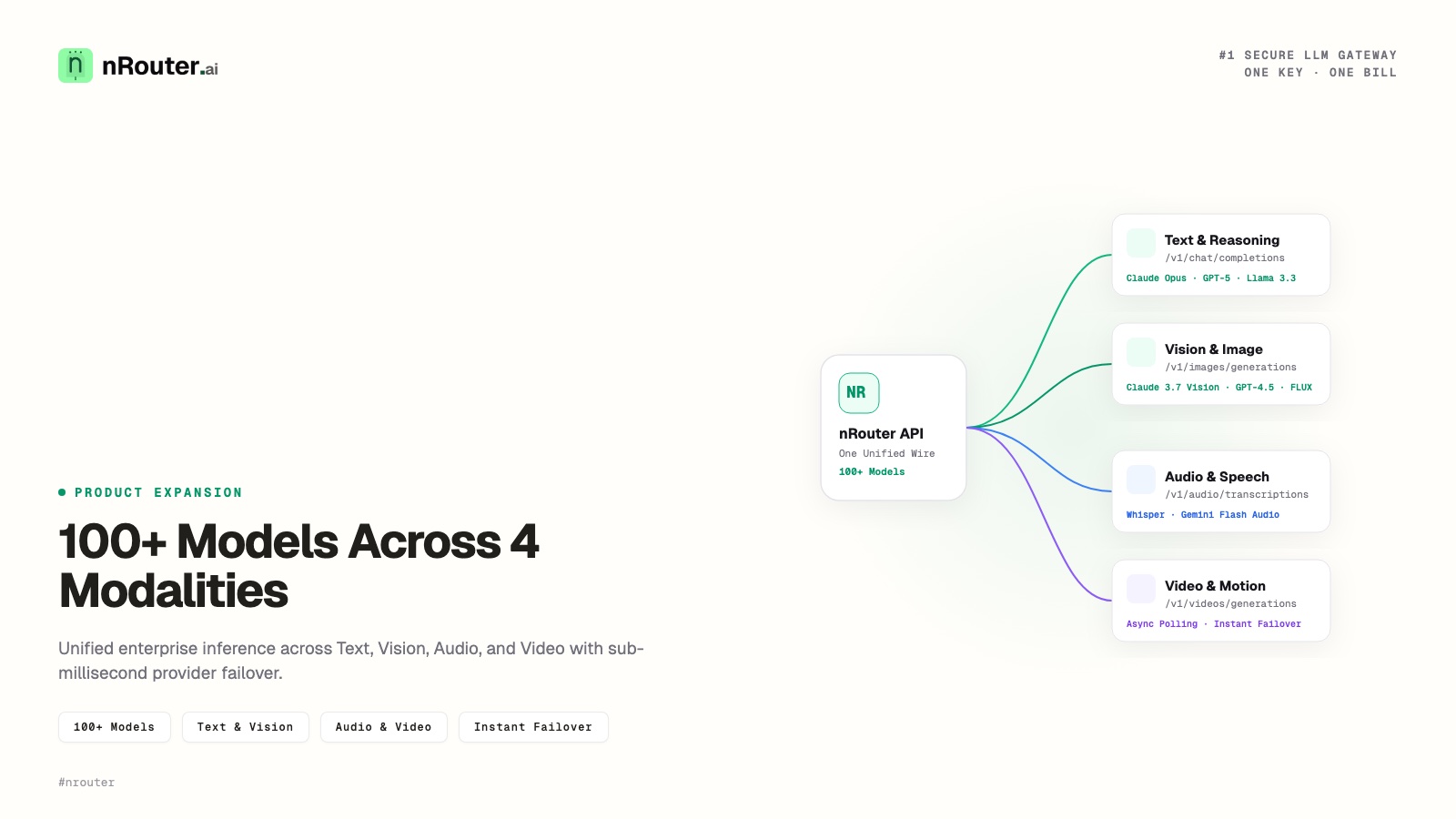
nRouter Expands Gateway to 100+ Multimodal Models
Unified enterprise inference across Google Vertex AI, Anthropic Claude, OpenAI, AWS Bedrock, Meta Llama, and DeepSeek with sub-millisecond provider failover and multimodal support.
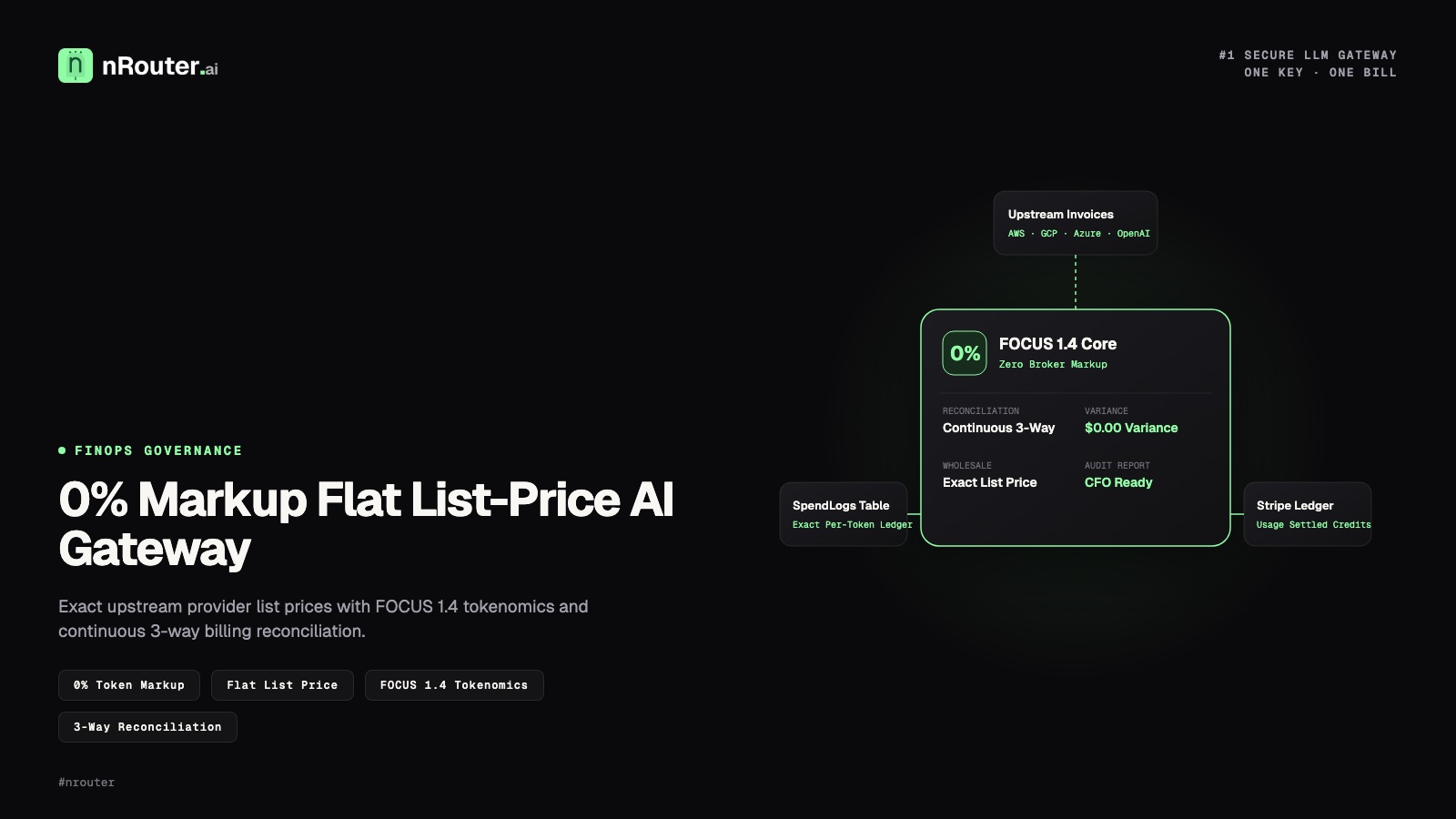
nRouter Abolishes Broker Markups with Flat List-Price Settlement and FinOps FOCUS 1.4 Tokenomics
Eliminating the 15% broker markup tax: nRouter establishes 0% per-token markup, settling at exact upstream provider list prices with automated 3-way FinOps FOCUS 1.4 reconciliation.
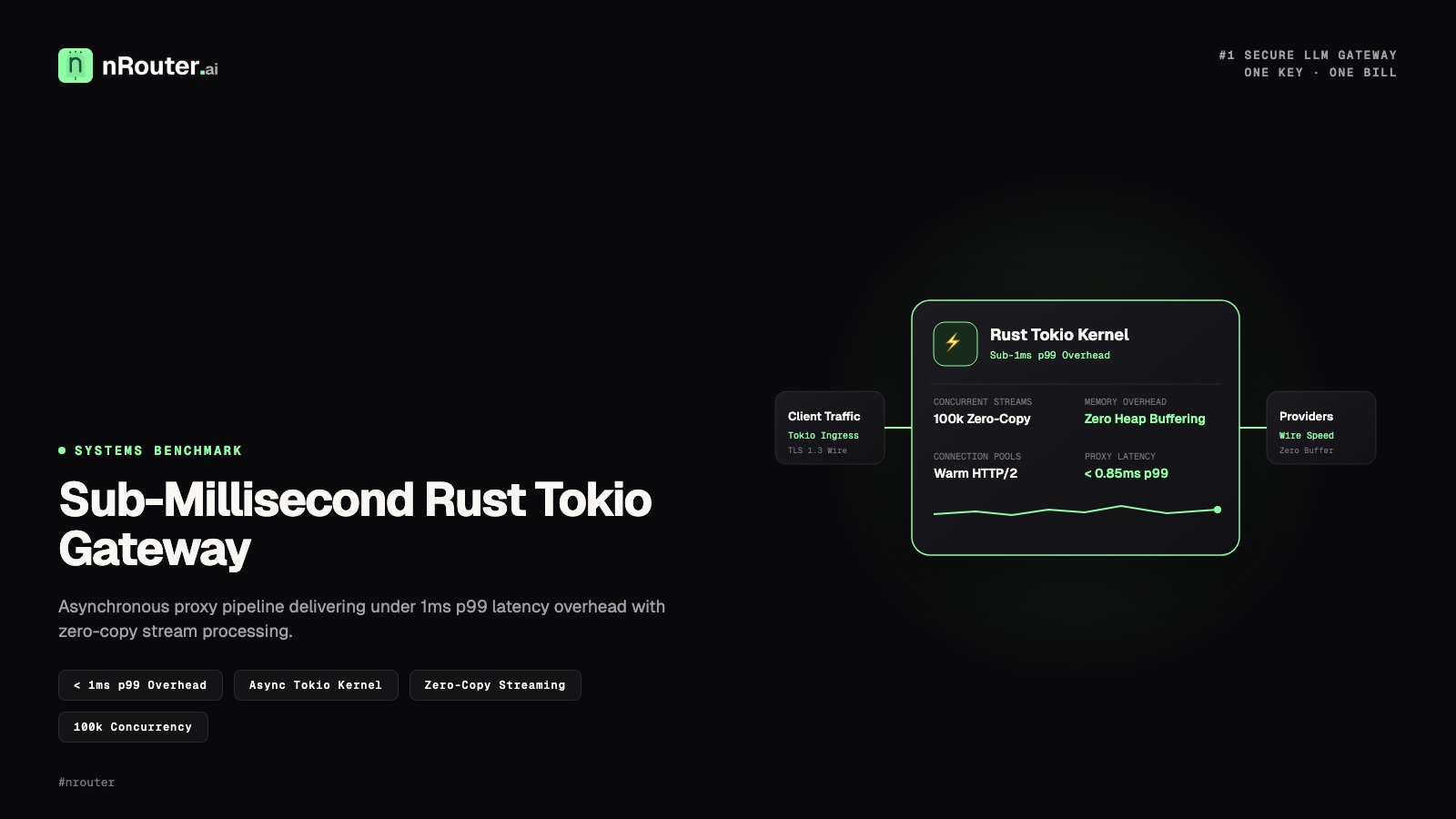
nRouter Sets New AI Gateway Speed Benchmark with Sub-Millisecond p99 Overhead Powered by Pure Rust Engine
Independent stress testing confirms nRouter's asynchronous Rust gateway streams tokens at wire speed with sub-millisecond p99 latency overhead, outperforming legacy Python and Node.js proxies.