Tag

prompt-management

2 posts tagged "prompt-management".

Editorial Guide

Production Prompt Management: Versioning, A/B Testing & Drift Control

Production prompt management bridges the gap between software engineering discipline and generative model nondeterminism. In modern enterprise architectures, prompts are not static strings or hardcoded client variables—they are version-controlled, auditable, and testable software assets. As engineering teams deploy complex multi-agent workflows and autonomous tool-calling pipelines, prompt orchestration becomes the critical control plane for output quality, cost efficiency, and system reliability.

Key Engineering Challenges

Silent Prompt Drift Across Model Revisions

Model providers frequently update weights, optimize quantization layers, or adjust default system instructions. A prompt carefully optimized for a specific model checkpoint can silently degrade upon upstream deployment updates, causing unexpected formatting failures, hallucinated tool calls, or degraded reasoning fidelity.

Multi-Model A/B Experimentation

Engineering teams need the ability to evaluate prompt variations across disparate model families (such as Anthropic Claude, OpenAI GPT, Google Gemini, and open-weights models) under real-world production traffic without requiring redeployments of downstream application services.

Dynamic Context Expansion and Token Ceilings

Modern applications dynamically inject user history, RAG document embeddings, and tool schemas into prompts. Without strict gateway-level context validation, unconstrained prompts overflow model context ceilings, trigger upstream provider 400 errors, or generate excessive token costs.

Zero-Downtime Rollback and Safe Deployment

Coupling prompts directly to application deployment pipelines slows release velocity and prevents rapid mitigation when regressions occur. Production systems require instant, zero-downtime rollback capabilities to revert faulty prompt revisions.

Architecture Taxonomy & Core Components

Dynamic Template Engine

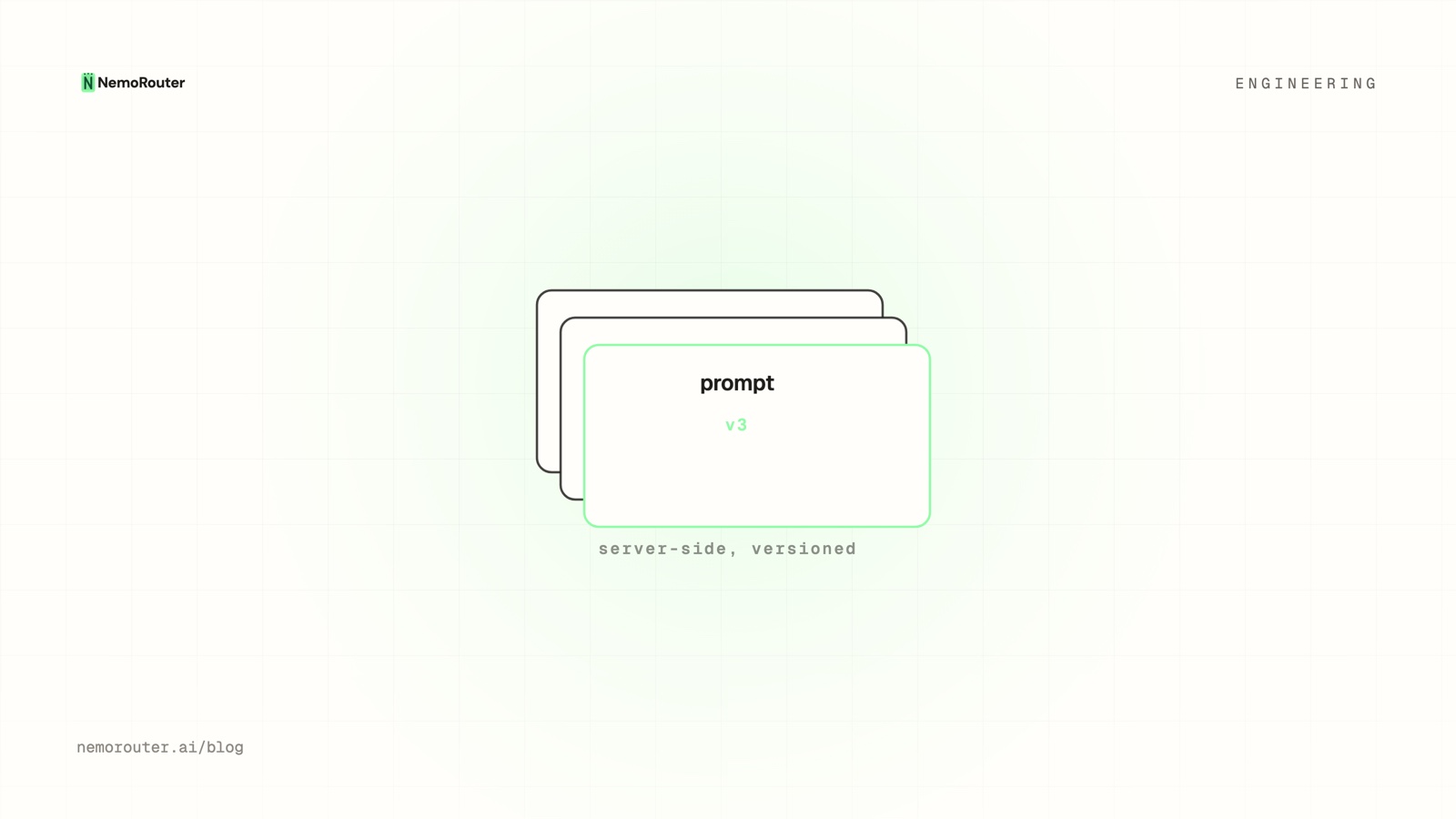
Server-side prompt versioning and Jinja2 variable interpolation decoupled from client deploy cycles.

Statistical A/B Router

Deterministic traffic splitting and variance analysis across competing model checkpoints and system prompts.

Semantic Response Cache

Sub-millisecond prompt cache hits with tenant-scoped encryption keys and fail-open guarantees.

How nRouter Automates Production Prompt Management

nRouter unifies prompt orchestration directly within its intelligent routing gateway. By decoupling prompt templates and dynamic variable interpolation from application codebases, teams can iterate and test prompts safely across development and production environments. nRouter's intent-based routing (Strategy::Intent) dynamically evaluates prompt complexity to dispatch requests to the most cost-effective model tier, while integrated semantic caching serves frequent prompt responses with sub-millisecond latency. Furthermore, full distributed OTLP tracing binds every prompt version to its corresponding request ID, latency, and cost record, providing complete visibility into model behavior and prompt performance.

Explore the articles below to learn best practices for versioning prompt templates, conducting statistical A/B evaluations, and maintaining deterministic model outputs.